
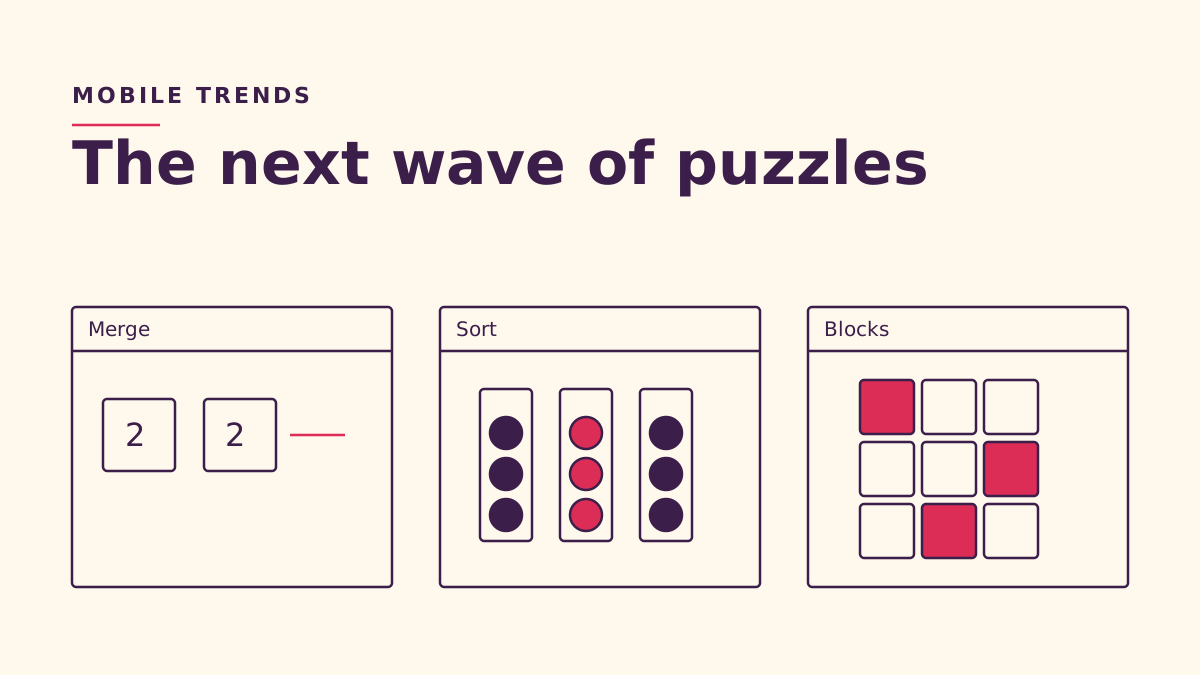
Puzzle games are winning a growing share of casual mobile spending in 2026 because familiar mechanics can support fresh challenges, longer progression and different monetization models. Merge, sort and block puzzles are the clearest growth signals in the available reports, but a growing genre does not guarantee an easy launch. For small studios, the practical opportunity is a distinctive puzzle loop with a content workload they can sustain.
Key takeaways
- Look beneath the market total: a stable casual market can contain rapidly growing puzzle subgenres.
- Separate downloads from spending: store purchase estimates leave advertising revenue outside the picture.
- Make progression serve the puzzle: story, decoration and collections should give players a reason to return without burying play.
- Choose a manageable scope: test the mechanic, difficulty and production burden before expanding the meta layer.
What does the mobile puzzle market data actually show?
GameDev Reports’ summary of AppMagic’s Casual Games Report puts casual mobile revenue at approximately $11 billion in the first half of 2026, effectively flat against the first half of 2025. Within that stable total, PocketGamer.biz’s coverage of the same report places puzzle at $4.9 billion in net player spending and more than 44% of casual spending in the first half of 2026. These are estimates of a defined market, not audited studio profits.
“The report uses Net IAP revenue estimations (revenue after tax and store commissions).”
— GameDev Reports, Report summary, GameDev Reports
The distinction matters when comparing a purchase-heavy merge game with an advertising-heavy block game. The same report summary says AppMagic excludes direct-to-consumer revenue and counts only iOS for China. Its purchase estimates therefore cannot establish total monetization across every channel. We could confirm the official AppMagic report location, but its body was not readable through our research tool; the figures here are explicitly attributed to accessible coverage.
A longer view helps explain the maturity story. Sensor Tower’s State of Mobile Gaming 2025 overview reports that hybridcasual in-app purchase revenue grew 37% in 2024 against 2023. Its State of Mobile 2026 overview describes gaming in 2025 as shifting from new-user volume toward lifetime value expansion. Those sources cover earlier years; they provide context, not evidence for full-year puzzle performance in 2026.
“With user acquisition costs rising, studios have embraced strategies such as Live Ops and hybrid monetization to maximize long-term revenue.”
— Oliver Yeh, CEO & Cofounder of Sensor Tower, Sensor Tower
Our interpretation at NabiGame is that “winning” should mean earning attention and sustaining satisfying play, alongside commercial viability. It should not imply that puzzle has overtaken every mobile genre. Nor should an aggregate revenue chart decide what an indie team builds: it says little about acquisition spending, operating costs or the distribution of success between games.
Which puzzle subgenres are growing?
- Match-3 remains large: PocketGamer.biz reports $2.5 billion in net spending in the first half of 2026, with revenue falling by less than 1% year over year while downloads grew 10%. Scale and growth are different signals.
- Merge is expanding: the same coverage reports $1.3 billion in the first half of 2026, up 74% against the corresponding period of 2025. That supports interest in merge, without demonstrating a typical newcomer’s prospects.
- Sort is accelerating: GameDev Reports’ AppMagic summary records sort revenue growth of 229% and download growth of 56% in the first half of 2026 against the first half of 2025.
- Block is attracting competition: that summary reports block revenue growth of 46% and download growth of 26% over the same periods, alongside more than 2,000 releases in the first half of 2026.
Use these categories cautiously. In his PocketGamer.biz analysis, Azur Games’ Eugene Tatonkin notes that the block category in his dataset includes arrow-style games. A developer examining a placement puzzle should not assume every game in a block trend line shares its mechanics, audience or revenue model.
The same analysis also cautions that analytics platforms classify games differently, so titles from one genre can land in separate categories.
Why do merge, sort and block puzzles offer useful design opportunities?
Our design view is that these formats offer compact actions with visible consequences: combine an object, free a space, complete a grouping. That gives a small team a clear hypothesis to test. Can a player understand the action, anticipate its result and enjoy making a better decision next time? The market reports identify momentum; the explanations below are design interpretations, not measured causes of that growth.
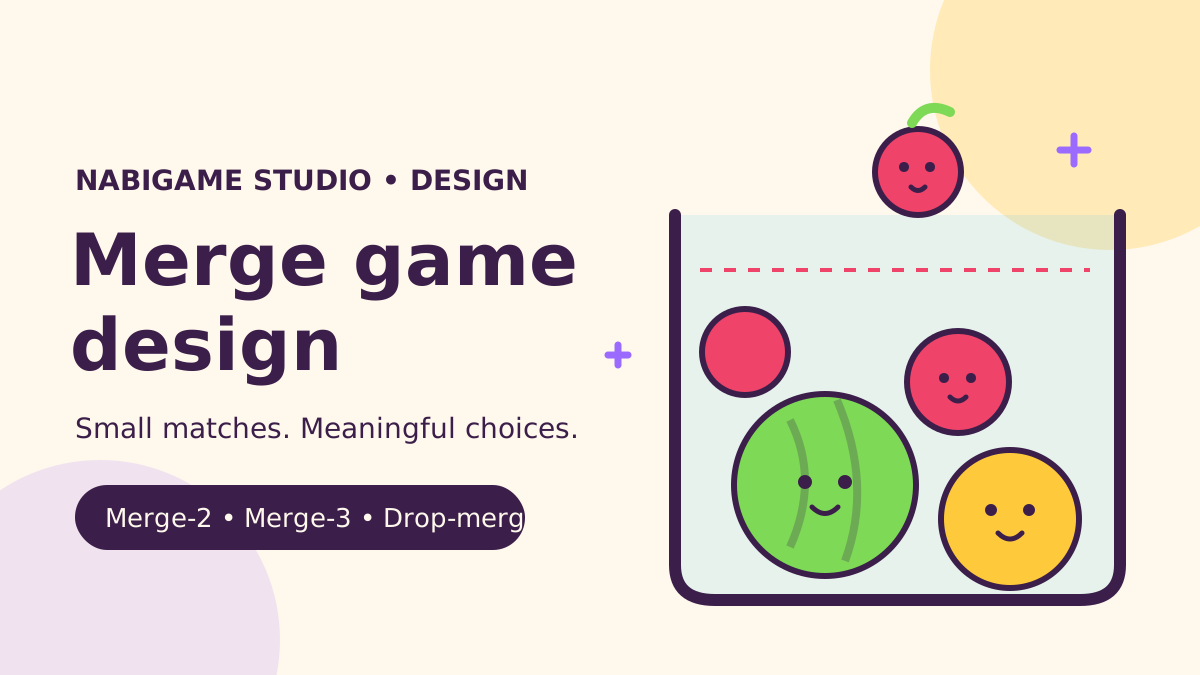
Merge: make every combination promise something
For a merge concept, we would prototype discovery and board management together. Combining objects should reveal something appealing, while keeping or spending an object should create a meaningful choice. A hypothetical cozy café could connect ingredient chains to customer requests, then let fulfilled requests unlock a visible improvement. The theme should explain the action rather than decorate an arbitrary checklist.
We would also distinguish spatial fruit merging from an order-driven merge board. Both involve combination, but they pose different design questions: placement and collision in the former, inventory and competing goals in the latter. Explore Juice Fruit as a NabiGame merge-puzzle reference, while avoiding assumptions that every merge format inherits the commercial profile of the reported category.
Sort: make constraints readable before making them difficult
For a sort prototype, our recommendation is to make the permitted moves and blocked paths obvious. A satisfying presentation cannot compensate for a rule players cannot predict. Introduce a constraint in isolation, let players practice it, then combine it with familiar rules. Try different layouts that demand planning, rather than relying on increasingly crowded screens.
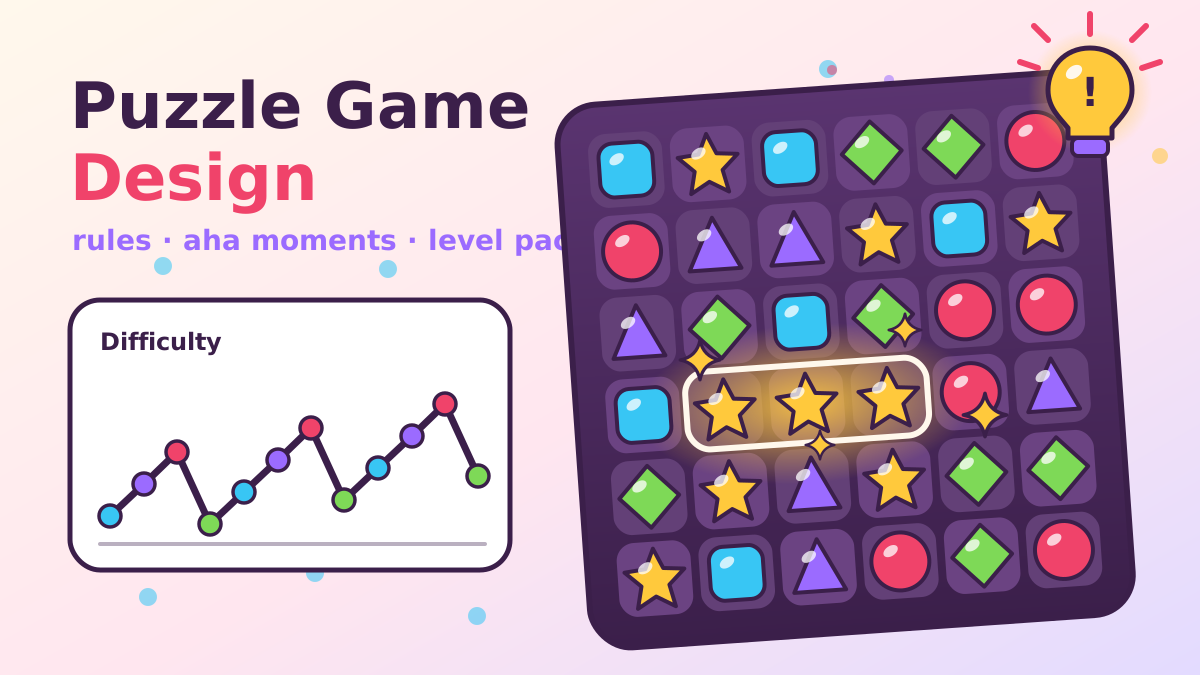
Color should communicate grouping, but shape, pattern or another cue should reinforce it. Test whether objects remain distinguishable on a small display and whether selected items look different from immovable ones. Our puzzle game design guide is a natural next read for translating a simple action into a considered difficulty curve.
Block: build decisions around space
For block concepts, we would start with the relationship between placement, clearing and recovery. Can players recognize a promising opening? Does a mistake leave an interesting rescue attempt, or merely delay an inevitable failure? Use those questions to compare board rules before adding a theme or a reward economy.
A placement game, sliding puzzle and arrow escape game need different balancing assumptions. Crystal Drop provides a block-slide drop puzzle reference within our games. For an indie concept, we would look for a distinct spatial decision or interaction rhythm rather than treating a new skin as sufficient differentiation.
How should story and decoration support a hybrid meta layer?
A meta layer is progression outside the immediate puzzle: a room to restore, characters to help, objects to collect or places to unlock. Our recommendation is to connect each reward to something players can recognize and care about. A repaired shop window or a character’s resolved problem can communicate progress more clearly than an unexplained currency counter.
This is a design option, not a conclusion that decoration or story caused the reported market growth. The selected reports do not isolate either feature’s effect on retention or spending. To evaluate the idea, compare a playable core with and without a small progression layer and observe where players become curious, impatient or confused.
- Decoration: suits a concept built around personal expression and visible transformation. Budget for art variants, previews and coherent spaces.
- Story: suits a concept whose characters create curiosity. Budget for writing, localization, pacing and readable presentation.
- Collections: suits a concept focused on discovery and completion. Budget for clear ownership states and rewards that feel distinct.
- Light progression: suits a compact puzzle with unlockable rules or environments. Consider it when a larger narrative would exceed the team’s capacity.
Our rule of thumb is to preserve a direct route back to the board. Offer the reward, show what changed and make continuing easy. If the meta layer requires a long tutorial before players enjoy the puzzle, simplify it. Cozy tone should inform how the game treats attention, failure and choice as well as how it looks.
What can small studios learn without copying market leaders?
NabiGame’s perspective is to select a promise the team can deliver repeatedly: calm spatial planning, playful discovery or a satisfying sequence of small challenges. Our studio background informs that preference for approachable games. The right concept should still make sense when the forecast changes and the headline growth rate disappears.
“Retaining, engaging, and monetizing existing players is more critical than ever.”
— Sensor Tower, State of Gaming report publisher, State of Gaming 2026
- Define the player promise. Describe the intended feeling and the decision that creates it. “Restore a tiny garden through relaxing sorting” gives design discussions more direction than “make a trending puzzle.”
- Prototype the core without the economy. Observe whether players understand the rules and choose to continue. Record confusion, dead ends and repetitive moves before investing in progression systems.
- Prove that content can vary. Create challenges around different constraints. Track the design and review effort required, and identify whether novelty depends on costly new assets.
- Add a modest meta layer. Try a room, collection or short character arc. Check whether it creates anticipation while keeping navigation and rewards understandable.
- Test a sustainable business model. Examine advertising and purchases separately, alongside retention, acquisition cost and ongoing production effort. Choose expansion based on observed behavior and financial assumptions you can explain.
For monetization, we recommend starting with clearly optional help or customization that fits the experience. Test the interruption cost of an ad, not just whether somebody watches it. Likewise, evaluate whether a purchase solves a reasonable player need or compensates for frustration the design could remove. Read our hypercasual games guide for related decisions about approachable loops and scope.
Can you afford to keep the game interesting?
Tatonkin's PocketGamer.biz analysis describes puzzle as a genre that demands a lot of content, and that is the cost small teams most often underestimate.
A launch plan should include the work required after release: level review, difficulty tuning, bug fixes, support and any promised events. We recommend building a small playable content set and timing how long it takes to design, check and revise. Procedural generation can propose layouts, but solvability alone does not establish whether a challenge is enjoyable or appropriately paced.
Choose the release format deliberately. A finite, polished puzzle and an ongoing service imply different commitments; either can be a reasonable indie goal. Our game distribution guide offers related platform considerations. If you need help shaping a feasible concept, our game development services are a starting point; you can also talk with NabiGame about the experience you want to make.
FAQ
Are puzzle games the biggest mobile gaming genre?
The cited AppMagic coverage identifies puzzle as the largest casual category by estimated store spending in the first half of 2026. That does not establish leadership across every mobile genre or revenue channel. Keep casual-market claims separate from whole-market claims.
Should a small studio make a merge game?
Consider merge if combination, discovery and board decisions fit your intended experience. The reported growth is a reason to investigate, not proof that a new game will recover its costs. Prototype the loop and estimate content needs before building a large progression system.
Does a puzzle game need decoration or story?
No; our recommendation is to add either only when it strengthens the player promise. Decoration creates an art workload, while story creates writing and localization responsibilities. A focused puzzle with satisfying unlocks may fit a small team better.
Do purchase revenue charts capture advertising income?
No, in-app purchase estimates do not include advertising income. The cited AppMagic summary also identifies direct-to-consumer and China platform coverage limitations. Compare similar revenue definitions before judging competing designs.
What should an indie team test first?
Start with rule comprehension, satisfying decisions and the ability to create varied challenges. Then test whether progression and monetization improve the overall experience. Expand when the evidence supports a workload and business model the team can sustain.
Sources
- PocketGamer.biz: Puzzle games rise as mobile genres compete for attention in 2026
- PocketGamer.biz: Puzzle accounts for 44% of casual mobile earnings in H1 2026
- AppMagic: Casual Games Report H1 2026 (official report location; body unavailable to our research tool)
- GameDev Reports: AppMagic mobile casual games report summary
- Sensor Tower: State of Mobile Gaming 2025, covering 2024
- Sensor Tower: Mobile gaming rebounds in 2024 press release
- Sensor Tower: State of Mobile 2026, covering 2025
- Sensor Tower: State of Gaming 2026
Comments
Loading comments…