
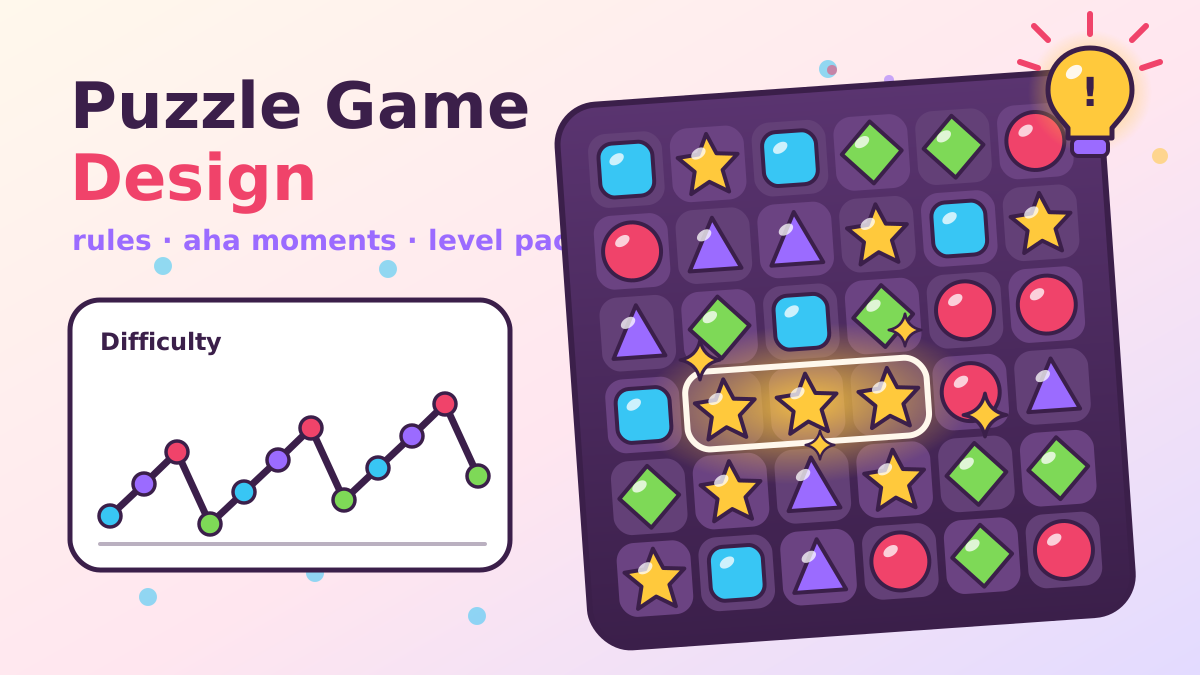
A great puzzle game gives players a small set of rules they can understand at a glance, then keeps showing them something new those rules can do. Every level should carry one clear idea, reward the moment it clicks with readable, juicy feedback, and pace its difficulty in waves so players stretch, succeed and catch their breath. Get those right and players keep coming back "for one more level".
At NabiGame Studio in Da Nang we make cozy merge, color, block, bubble and egg-shooter puzzles. This guide pairs our own design principles with advice from designers and studios who have written about the craft.
Key takeaways
- Keep the rule set small and visible. If a player can't predict what a move will do, it isn't a puzzle yet.
- Design every level around one idea, and cut anything that doesn't serve it.
- Use a sawtooth difficulty curve: teach, test, twist, then rest. Avoid long runs of hard levels.
- Teach through level layout and feedback, not text boxes.
- Every level must be beatable without boosters. Boosters should save time or rescue a near-win, never act as a paywall.
- Playtest with people who don't play puzzle games, and don't help them.
What makes a casual puzzle game satisfying?
Satisfaction in a puzzle comes from understanding, not from winning. Brute-forcing a level by luck brings relief; suddenly seeing why the pieces fit brings the feeling of being clever, and that is what brings players back. In a 2015 Rock Paper Shotgun feature on puzzle design, programmer and designer Jonathan Whiting described it this way:
“When I’m excited playing puzzle games it’s because each new puzzle is forcing me to understand something new about the mechanics of the world I’m taking part in.”
— Jonathan Whiting, puzzle game developer, Rock Paper Shotgun
Casual puzzle games are lighter than Sokoban-style "thinky" games, but the same principle holds at a smaller scale. A match-3 player who works out that clearing the bottom row first shakes loose a cascade is learning the system.
Clear rules come first
The rules of a casual puzzle should fit in one sentence: "drop fruit, matching fruit merge", "tap a bottle to send its ink to the matching color". Players should be able to predict the result of a move before they make it. If a result surprises them, it should be because they missed something, not because the game hid it.
Practical checks for clear rules:
- One look, one read. Each piece type should be recognizable by shape and color, so it still reads at thumb size and for color-blind players.
- Visible state. Counters, locks and timers sit on the piece they affect, not in a corner of the UI.
Every level needs one idea
Jonathan Blow, designer of Braid and The Witness, put it simply in the same interview:
“A puzzle should know what the point is, what it’s trying to illustrate to you…”
— Jonathan Blow, designer of Braid and The Witness, Rock Paper Shotgun
Blow went on to argue for removing everything that doesn't contribute to that point. Alan Hazelden (Draknek) added that a level bigger than it needs to be should be cut down to respect the player's time. Playrix makes the same point for match-3: in a talk summarized by Game World Observer, Gardenscapes lead game designer Aleksandr Shilyaev said each level should have an idea, and that more than three or four elements per level starts to feel chaotic and confusing.
A habit we recommend: write each level's idea down in a few words before placing anything. In a color puzzle like Blot Up Ink that might be "frozen bottle blocks the only red" or "mystery lid hides the color you need last". If you can't name the idea, the level is probably filler, so cut it or merge it into another one.
Why does feedback and "juice" matter so much in puzzles?
The aha moment happens in the player's head, but the game has to confirm it straight away. Juice is the layer of motion, sound and particles that tells the player "yes, that worked". Martin Jonasson and Petri Purho's well-known talk on the subject is summarized on Game Developer:
“Juice is typically auditory or visual, but it doesn't really need to be…it's about maximum output for minimum input.”
— Martin Jonasson, independent developer, Game Developer
In a puzzle, juice has a second job that action games don't always need: it has to explain what happened. A cascade in Crystal Drop is exciting, but if three rows clear at once the player also needs to see which bar caused it. Otherwise they can't repeat it on purpose. Our rules of thumb:
- Sequence, don't stack. Resolve chain reactions one step at a time, with a short beat between them, so cause and effect stay readable.
- Escalate with the combo. Raise pitch, particle count or screen shake with each link in a chain so bigger plays feel bigger.
- Telegraph danger early. A bubble field about to reach the bottom, or an egg chain near the skull cave, should change color or tempo before it's too late.
For the technical side of this, see our devlogs on trails and particle bursts and on game feel and forgiving controls.
How should a puzzle game's difficulty curve work?
A straight ramp, where every level is a little harder than the last, tires players out. Many level-based puzzle games use a sawtooth curve instead: difficulty climbs over a short group of levels, peaks, drops to an easy "rest" level, then climbs again from a higher baseline.

We think of each wave in four beats:
- Teach. Introduce one new element in a level where it is almost impossible to fail. The layout itself shows what it does.
- Test. Ask the player to use it deliberately, with a little pressure from moves or space.
- Twist. Combine it with something they already know, or show a side effect they haven't seen. This is where most aha moments live.
- Rest. An easy, generous level. The player feels skilled, uses the new trick freely and gets a burst of rewards.
The rest beat isn't optional. Playrix's Aleksandr Shilyaev warned about long runs of levels at the same high difficulty, which happened in Gardenscapes and had to be fixed:
“If you throw several difficult levels in a row at the player, they can get demoralized and stop playing.”
— Aleksandr Shilyaev, Lead Game Designer at Playrix, Game World Observer
Hard is not the same as fun
At GDC 2024, King explained how it judges Candy Crush Saga levels, as reported by Mobilegamer.biz. Head of central insights Jan Wedekind urged designers to separate difficulty from fun:
“Just because they’re hard doesn’t mean they’re not fun, and inversely you can find easy levels which don’t have a lot of churn on them but they’re not much fun.”
— Jan Wedekind, Head of Central Insights at King, Mobilegamer.biz
The same report notes King's finding that longer levels are less likely to be fun, and that a really hard level should also be really short. Our rule of thumb for peak levels in a merge puzzle like Juice Fruit: when a hard level feels bad, try making it shorter, so a retry costs less, before piling on extra moves.
How do you onboard players without text?
Mobile players skip text. Stuart Burfield, developer of the block-pushing puzzle Puzzledorf, wrote about this lesson on Game Developer:
“Most people won’t read text in tutorials. They will mindlessly zip through it and think they can figure it out on their own.”
— Stuart Burfield, developer of Puzzledorf, Game Developer
His playtest method was to put new players in front of the game and refuse to help, because he wouldn't be there to help real customers later. Teaching through design looks like this:
- A first level with one possible move. A pulsing hand or ghost piece shows it. The player does it and wins.
- Constrained boards. Introduce a new blocker on a board so small there is only one sensible place to interact with it.
- Show, then name. Let players see a frozen bottle thaw before any label calls it "frozen".
- Undo and restart stay visible. Burfield found players forgot these controls, so he kept them on screen in every level.
Fail states and fairness
Losing is fine. Feeling cheated is not. A fair fail state follows three rules: the player can see it coming, they can see why it happened, and they can try again within seconds. In Bubble Fall, wall bounces are shown with an aim line, so a missed shot is the player's own call, not the physics engine's. In Dino Egg Blast, the egg chain speeds up visibly as it nears the cave, so the loss never comes out of nowhere.
Randomness needs extra care. A level shouldn't be winnable on one shuffle and impossible on the next. We generate or check spawns so the needed piece shows up within a fair window, and we treat "lost because the right color never came" as a bug.
Boosters and monetization: where is the ethical line?
Boosters (hammers, shuffles, extra moves, color bombs) are part of the genre. The question is whether a booster helps a player or ransoms a level. Playrix's rule is a good line to hold:
“You should be able to beat every match-3 level in your game without using boosters.”
— Aleksandr Shilyaev, Lead Game Designer at Playrix, Game World Observer
King's GDC talk also covered the business side. According to Mobilegamer.biz, Candy Crush Saga's notoriously hard level 65 became its highest-converting level but also caused the most churn, and King's testing found that making it easier kept players longer. Spikes built to sell boosters can earn short-term money while driving players away.
Our stance, as a small studio: boosters, like the four in Juice Fruit or the ones that sit alongside the stones and frozen bottles in Blot Up Ink, should rescue a near-win or skip a tedious end-game. Players should be able to earn them through normal play, not only through the shop, and no level should be tuned so that it's only realistically beatable with a booster.
Endless mode or levels?
They answer different moods. Level-based play suits authored ideas, clear goals and a sense of progress on a map. Endless play suits relaxing, high-score chasing and short sessions with no fail pressure. Many games now ship both: Juice Fruit has 50 handcrafted levels plus a relaxing Endless mode, and Bubble Fall pairs 100 levels with Endless. In endless modes the difficulty curve moves inside a single run. Speed or spawn complexity rises over time, and the "rest" beats come from big clears that open up the board.
Sub-genre notes: match-3, merge, block and bubble shooter
Each casual puzzle sub-genre has its own core loop, and its own way of going wrong:
- Match-3 (e.g. Sweet Candy): swap to line up three or more. Depth comes from specials, combos and blockers. Watch out for luck-driven boards where cascades decide the outcome more than the player does.
- Merge (e.g. Juice Fruit): combine two of a kind into the next tier. The fun is in planning space for future merges. Watch out for runaway clutter, so make the next piece visible and reward tidy stacking.
- Block puzzle (e.g. Block Puzzle Master 2020, Crystal Drop): place or slide shapes to fill rows. Players love the spatial planning and the big multi-line clear. Watch out for piece droughts that make a board unwinnable.
- Bubble and egg shooters (e.g. Bubble Fall, Dino Egg Blast): aim and match colors in a cluster or moving chain. The fun is in skillful aim and dropping big clusters. Watch out for imprecise aiming, which turns misses into frustration. Show the trajectory, bounces included.
- Color sort (e.g. Blot Up Ink): route colors to the right destination in the right order. Players enjoy calm sequencing and the satisfaction of a finished picture. Watch out for hidden information that makes a mistake impossible to foresee.
Playtesting tips for puzzle games
- Watch, don't explain. Like Burfield, stay quiet. Every time you want to speak, write down the moment instead.
- Test with non-puzzle players. Your team solves your levels too quickly to judge difficulty.
- Record where people pause. A long pause before a move is thinking (good). A long pause before the first move is confusion (bad).
- Compare intended and actual difficulty. Playrix describes comparing its projected difficulty curve with the curve from real results, and investigating where the two diverge. A spreadsheet of attempts per level is enough to start.
Puzzle game design checklist
- Can the core rule be explained in one sentence?
- Does every level have a written one-line idea?
- Are there four or fewer element types on the board?
- Does the curve follow teach, test, twist, rest, with no long run of hard levels?
- Are hard levels also short?
- Can a new player get through the first five levels without reading anything?
- Do chain reactions resolve in a readable sequence?
- Is every loss foreseeable and every retry quick?
- Is every level beatable without boosters?
- Have people outside the team played it while you stayed silent?
If you're planning a casual puzzle game and want a team that has shipped merge, block, bubble and color puzzles, take a look at our game development services, or simply say hello and tell us about your idea.
FAQ
What makes a good puzzle game?
A good puzzle game has a small set of clear, predictable rules, levels built around a single idea each, and a difficulty curve that keeps teaching the player something new. Satisfying feedback confirms each success, and fair fail states make losses feel like the player's own mistakes.
What is a sawtooth difficulty curve?
A sawtooth difficulty curve rises over a short group of levels, peaks, then drops to an easier rest level before climbing again from a slightly higher baseline. It keeps overall progression moving upward while giving players regular breathers, so they don't get worn down by long streaks of hard levels.
Should every match-3 level be beatable without boosters?
Yes. Playrix's design guidance is that every match-3 level should be beatable without boosters. Boosters work best as helpers that save time or rescue a near-win, not as a requirement for progress.
How do you teach puzzle mechanics without a tutorial?
Use the level itself as the tutorial: a first board with only one possible move, small constrained layouts that isolate each new element, visual hints such as a ghost piece or pulsing hand, and controls like undo and restart that stay visible on screen.
Is endless mode or level-based mode better for casual puzzle games?
Neither is strictly better. Level-based modes suit authored ideas and a clear sense of progress, while endless modes suit relaxed, score-chasing sessions. Many casual puzzle games offer both so players can choose depending on their mood.
Sources
- Marsh Davies, "How To Make A Puzzle Game", Rock Paper Shotgun (2015)
- Oleg Nesterenko, "Playrix: Creating levels and elements for match-3 games", Game World Observer (2019)
- Neil Long, "How King defines a 'good' Candy Crush Saga level – and constantly prunes the bad ones", Mobilegamer.biz (2024)
- "Video: Is your game 'juicy' enough?", Game Developer (2013)
- Stuart Burfield, "Reflections on tutorial design in Puzzledorf", Game Developer (2021)
Comments
Loading comments…