
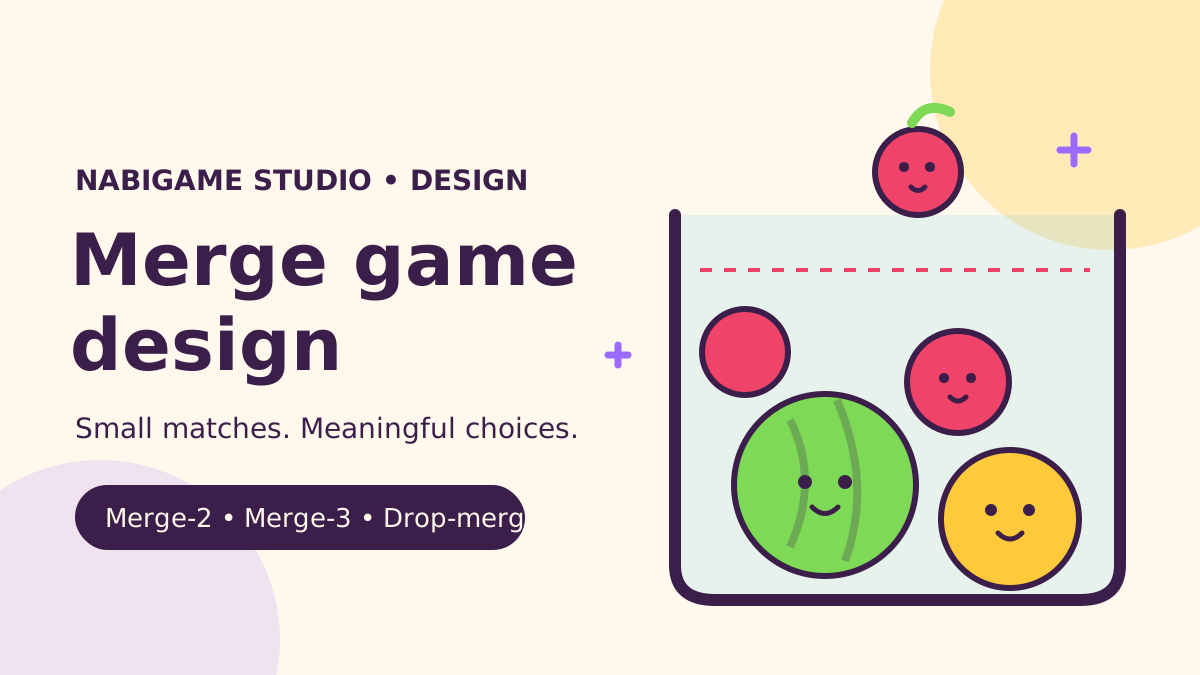
Merge game design turns matching objects into a choice about progress and space: combine items, improve them, and decide what to keep. Merge-2 emphasizes production chains, merge-3 adds grouping and collection decisions, and Suika-like drop-merge games make placement and physical crowding the puzzle. A satisfying design makes each transformation readable, gives players a useful next goal, and leaves room for recovery.
Key takeaways
- Choose the source of tension before adding story, energy, or a shop.
- Treat empty space as a resource alongside items and currency.
- Balance generators, orders, and storage together; tuning them separately can create dead ends.
- Reward planning with visible progress and make stopping feel comfortable.
- Use market charts as context, not as a revenue forecast for an indie game.
How do merge-2, merge-3, and drop-merge differ?
The shared verb is combining matching objects into something more valuable. The important difference is what the player controls before that transformation. For a prototype, we recommend choosing a clear interaction model and testing its appeal before borrowing features from another merge subgenre.
- Merge-2: drag matching items together to advance a chain. On a persistent production board, the interesting choice is which chain to pursue, which order to serve, and which unfinished items deserve storage.
- Merge-3: bring matching objects into a group. Group size and adjacency can make organization part of the strategy, especially when holding items enables a more efficient merge.
- Drop-merge: place a falling object above a container and let contact trigger a transformation. Position, pile shape, and the space occupied by larger objects create the challenge.
These are design families, not promises that every game follows identical rules. As checked in 2026, the official Merge Dragons! support page explains its larger-group incentive:
“But, if you merge 5 things, they turn into 2 better things!”
— Gram Games Support, Merge Dragons! Help Center
Our design interpretation is that saving a group trades immediate space relief for future efficiency. A game using that rule should show the benefit before the player accidentally combines a smaller group. For drop-merge, the publisher's description on Nintendo states the spatial goal directly:
“To prevent the fruits from overflowing from the box, collide the same kind of fruit.”
— Aladdin X, publisher, Nintendo
That difference matters for scope. An arcade container can support a complete experience without an energy economy or renovation map. NabiGame's Juice Fruit merge puzzle is a natural starting point for readers interested in fruit-themed merging; the recommendations here describe design options, rather than claiming its implementation follows every system discussed.
What should the core loop accomplish?
We recommend writing the loop as an action sequence with an understandable payoff. For a production game: generate an item, merge toward a requested object, deliver it, receive a reward, and choose the next goal. For an arcade game: inspect the pile, choose a landing position, drop, watch the result, and reassess the available space.
Each stage should answer a player question. What can I do now? What will this become? Why do I want it? What changed after I succeeded? If the reward merely increments a distant counter, the transformation can feel disconnected from progress. A completed order should visibly leave the board, and a decoration reward should visibly change the destination.
Our rule of thumb is to prototype the loop with plain shapes before producing a large item catalog. Ask testers to explain their next move without prompting. If they can identify matches but cannot choose a goal, the missing piece is probably prioritization or reward clarity. More decorative content will not resolve that uncertainty.
Why is board space an economy?
Empty space determines what players can produce and rearrange. A nearly finished chain occupies room that could support another goal; deleting it may release space while losing invested effort. We recommend treating that tradeoff as the central balancing problem on a persistent board.
A historical analysis published by Game Developer in 2021 identified the relationship clearly:
“The relationship between item spawners, quest objectives and merging board size is THE crucial balancing act for Merge.”
— Game Developer, Game Developer
The article credits Abhimanyu Kumar and Eva Grillova and discusses repetition, changing gameplay context, and effort relative to rewards. We use it as a design lens, not as evidence of today's market performance. Its practical implication is to test a crowded board together with the active orders and available production sources.
How can space create choices without creating frustration?
Give each item a legible future. A chain preview, an order marker, and a clear distinction between producers and consumable items help players decide what deserves a slot. We recommend protection or confirmation for deleting valuable producers, while keeping routine rearrangement quick.
Construct awkward test states deliberately: unrelated partial chains, a producer waiting to recharge, and an order requiring something not currently present. Check whether players have an understandable route back to progress. Consider storage, a sell action, an alternate order, or a clearly bounded reset. The recovery path should be visible before the board becomes unusable.
In drop-merge, think about reachable space rather than just empty area. A cavity under a large fruit may look available but be inaccessible to a falling object. We recommend testing container width, object sizes, and collision behavior together. A successful merge should create a predictable transformation even when the resulting object makes the pile less convenient.
How should generators and energy work?
Generators define what can enter a production board. Energy can limit how much production a session allows; recharge timers can limit a particular source. Our recommendation is to introduce these constraints separately so players understand which resource is missing and what they can do next.
Track the whole path from input to order completion, including unwanted outputs and the slots they occupy. An order may look modest in the reward menu yet require extensive production and cleanup. Judge its cost in player effort, occupied space, and waiting, rather than looking only at the final item tier.
If a generator has multiple output chains, we recommend giving the secondary chain a useful destination. Repeatedly receiving items with no current purpose can make production feel wasteful. Alternatives include orders that absorb those outputs, optional collection goals, or a fair way to clear them.
Energy boosts should explain their tradeoff before activation. Faster progress, increased energy use, and different output tiers are separate concepts. For a cozy game, our preference is a clear session endpoint and an easy return later. A player should be able to stop after a small accomplishment without feeling that every unfinished chain is an emergency.
What makes merging satisfying?
Our view is that satisfaction comes from anticipation, readable transformation, and useful consequence. The player sees a match, commits to it, recognizes the upgraded object, and understands what that unlocks. Sound and particles can reinforce that sequence, but cannot substitute for it.
Make the transformation easy to follow
Keep the result near the action and distinguish neighboring tiers through silhouette as well as color. Give a larger fruit a recognizable shape change; give an upgraded tool a clearer function. Avoid effects that cover nearby objects just when the player needs to plan the next move.
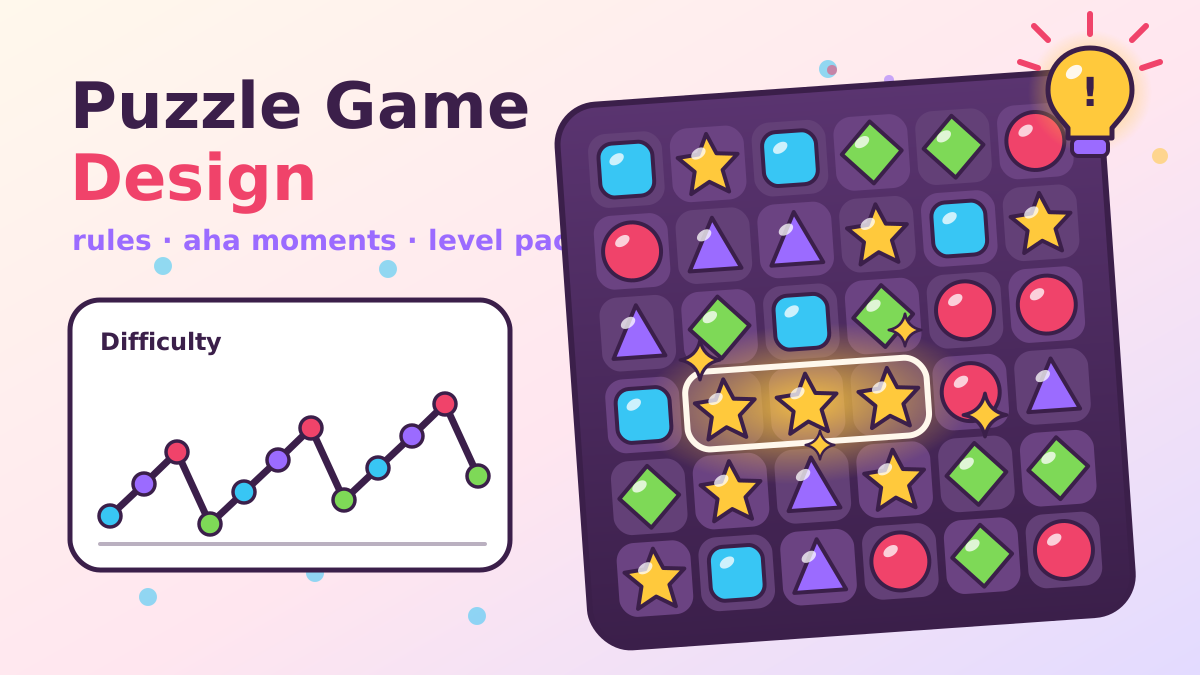
We recommend brief squash, a clean sound cue, and restrained celebration for ordinary merges, reserving stronger feedback for discoveries or major goals. Offer sound and motion controls. Our broader puzzle game design guide explores readable rules, while trails and particles offers related visual inspiration.
Let surprises preserve trust
For a physics prototype, test whether an apparently safe placement behaves consistently. We recommend checking rolling, bouncing, simultaneous contacts, and transformations near the container boundary. Surprise is enjoyable when the player can explain the chain reaction afterward; an unexplained launch or inconsistent contact feels harder to learn from.
How do decoration and story support the metagame?
Decoration can give item production a visible destination: restore a corner, choose a furnishing, or complete a shared space. Story can attach meaning to an order through a character's request and a later consequence. Our preference is to make those rewards coherent with the objects being produced.
Offer short narrative beats that players can skip or revisit. Show completed changes together so progress remains tangible between sessions. A mystery can encourage curiosity, but delaying every answer risks making the board feel like a toll gate. We recommend delivering satisfying local resolutions while leaving broader questions open.
Changing goals can also refresh an established board. A new order pattern, temporary production rule, or optional collection challenge offers a different decision. Introduce changes with enough explanation that experienced players understand which knowledge still applies. For a small team, we would favor reusable variations over an expanding stream of bespoke content.
How should difficulty and monetization fit together?
We recommend distinguishing strategic difficulty from waiting. A crowded board with meaningful alternatives tests planning; an unavailable generator with no alternative simply pauses progress. Test those experiences separately, then examine how they interact with offers.
In her 2026 Deconstructor of Fun analysis, mobile game consultant Aylin Yazıcı describes the continuing nature of a production board:
“Half-completed merge chains are exactly where you left them.”
— Aylin Yazıcı, Mobile Game Consultant, Deconstructor of Fun
Her analysis connects that persistence with planning and purchases that maintain momentum. Our recommendation is to preserve continuity while also giving players comfortable stopping points. Sell convenience clearly: an optional energy refill, a cosmetic choice, or an explicitly described pass. Avoid implying that a purchase guarantees an order when output remains uncertain.
For an arcade design, a rewarded continue is an option to evaluate, not an automatic requirement. State exactly what the rescue changes and ensure restarting remains convenient. Keep offers away from active aiming and merging; an interruption can obscure the action the player is trying to understand.
What do the market charts actually tell us?
For the first quarter of 2025, mobilegamer.biz reported AppMagic's estimated worldwide merge-2 revenue growth:
“The worldwide merge-2 market saw Q1 revenue growth of 110% year-over-year and 21% quarter-over-quarter.”
— Tom Ivan, author, mobilegamer.biz
Read that alongside the charts in AppMagic's Mobile Market Landscape 2026 report: for 2025, the leading titles captured nearly 80% of merge segment revenue. The report covers worldwide App Store and Google Play in-app purchase revenue and excludes webshops and other alternative monetization sources. The broader merge category and merge-2 subset are different scopes, so their figures should not be combined into a single growth calculation.
Our takeaway is that category growth can coexist with concentrated competition. Those charts do not establish what a new indie title will earn, nor do they show that copying an energy system causes success. Choose a sustainable content scope and publishing plan; our game distribution guide provides related context.
What should an indie prototype test first?
- Define the pleasure. Decide whether the promise is organizing, discovering, decorating, or creating a surprising cascade.
- Make a playable chain. Use distinguishable objects and show the next useful goal without explanatory overload.
- Stress the space. Start testers with awkward partial progress and observe their recovery choices.
- Add pacing. Try production constraints or harder placements only after the basic action is enjoyable.
- Check the return. Reopen a saved board and ask whether the next action is obvious. For arcade play, check whether failure suggests a different approach.
- Review offers last. Confirm that their promised benefit is understandable and that unpaid progress remains enjoyable.
At NabiGame Studio, our preference is a compact, polished interaction that supports cozy play. Read more about the studio or explore our game development services. If you are shaping a merge prototype and want to discuss its central design tradeoffs, get in touch.
FAQ
Is merge-2 easier to design than merge-3?
The input rule may be simpler, but we would not assume the complete game is easier to balance. Persistent orders, generators, and storage create interacting constraints that need testing together.
Does a merge game need energy?
No; we recommend choosing energy only when it serves the intended production and session rhythm. A drop-merge arcade prototype can instead build its challenge around placement, space, and restarting.
How can a merge game feel cozy while remaining challenging?
Our recommendation is to make consequences legible and recovery accessible. Ask players to prioritize and plan while giving them a comfortable place to pause and a clear next action when they return.
Should every merge free space?
We would avoid making that a universal rule across subgenres. On a grid, combining items can release slots; in a physics container, the resulting object's size and position also matter. Communicate the actual rule through predictable feedback.
What should developers measure during playtesting?
We recommend recording confusion, blocked states, discarded items, and whether testers can explain their goals. Pair behavioral observations with questions about satisfaction and stopping; a long session alone does not explain whether the experience felt good.
Sources
- Gram Games Support: merging larger groups
- Nintendo: publisher description of Suika Game
- Game Developer: merge growth and design analysis
- Deconstructor of Fun: merge-2 monetization analysis
- mobilegamer.biz: first-quarter 2025 market data
- AppMagic: Mobile Market Landscape 2026, merge charts and methodology

Comments
Loading comments…