
Vietnam became a hub for mobile and casual games through established outsourcing experience, local publishing knowledge, and developers building for international audiences. For partners considering Vietnam in 2026, the useful question is which studio fits the project: evaluate genre skills, delivery quality, total costs, and the separate requirements for publishing games in Vietnam.
Key takeaways
- Vietnam’s mobile reach extends beyond its domestic player market; downloads should not be treated as proof of profitability.
- Outsourcing, original development, and local publishing require different capabilities.
- Da Nang has a broader technology ecosystem, but assess each game team on its own work.
- Compare complete proposals and start with a paid, reviewable milestone.
- Check current Vietnamese release requirements before committing to a domestic launch.
Why did Vietnam become a mobile game hub?
Outsourcing helped build a development foundation
Naavik’s industry analysis published in 2025 traces Vietnam’s development opportunity to established external development companies, including Glass Egg, Sparx, and Gear Games. It connects that history with experience across art, engineering, quality assurance, and live operations. This is a useful explanation of the ecosystem’s development, rather than a guarantee about any individual supplier.
“Foreign companies like Ubisoft and Gameloft have also set up shop in Vietnam.”
— Naavik, Naavik
Our view is that production experience matters most when it becomes visible in delivery. A studio should be able to explain how it handles an incomplete brief, an asset revision, or a bug that only appears on a particular device. A polished reel starts the conversation; a clear account of responsibility and handoff makes the relationship easier to assess.
Publishing knowledge and original games reinforced each other
The same Naavik analysis describes local publishing as another source of operating knowledge and identifies Magic Tiles 3 among internationally recognized Vietnamese games. Together, those strands suggest a plausible explanation for the country’s mobile specialization: teams could draw on production skills while learning how games reach audiences. We would treat that as an industry interpretation, not a formula every studio followed.
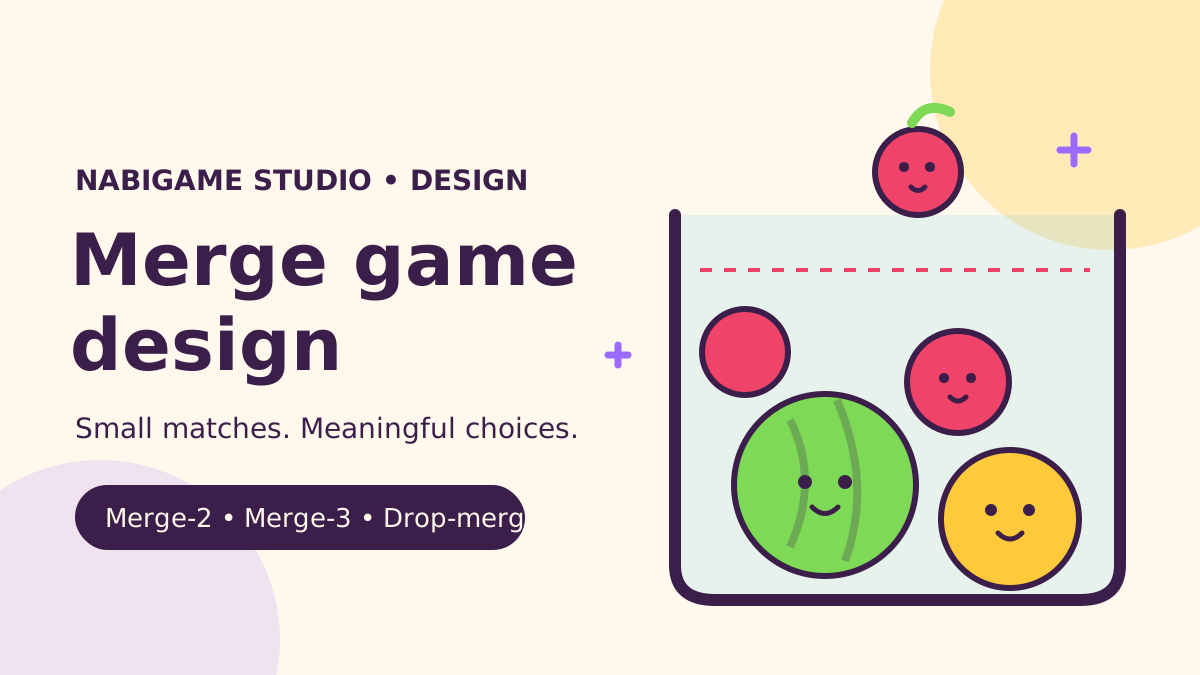
For casual games, our rule of thumb is to prototype the player’s central action before building an elaborate progression system. Can someone understand what to do, recognize a useful move, and enjoy the response? Our puzzle game design guide explores those decisions in more detail.
International reach is the stronger signal
Sensor Tower’s report published in 2025 says three Vietnamese publishers were among the global top fifteen by downloads in 2024. Its methodology uses estimated App Store and Google Play downloads and excludes pre-installs, re-downloads, and third-party Android marketplaces. That scope matters when comparing headlines from different reports.
“A majority of these downloads originate from overseas markets, showcasing the region's capability to create globally appealing mobile games.”
— Sensor Tower, Sensor Tower
This points to an export opportunity, but it does not establish the profitability of the games behind the ranking. We recommend asking separate questions about audience demand, production expense, acquisition spending, and continued engagement. A widely installed game and a sustainable business are different outcomes, and a national ranking cannot tell you which outcome a proposed project will achieve.
Which Vietnamese games and studios illustrate the opportunity?
Flappy Bird is history, not a repeatable business plan
TIME’s reporting from 2014 documents Vietnamese developer Dong Nguyen’s removal of Flappy Bird after its sudden popularity. The episode remains a useful historical example of a small Vietnamese developer reaching an international audience. We would avoid using its reported earnings as a benchmark for a contemporary arcade prototype.
Our design takeaway is modest: an understandable interaction can be memorable without a large content catalogue. The business recommendation is equally modest: plan support, ownership, and release responsibilities before launch. A compelling mechanic does not remove the need for a manageable operating plan.
Amanotes and iKame show different product directions
Amanotes’ Magic Tiles 3 appears in Naavik’s 2025 discussion of Vietnamese games. Separately, Sensor Tower highlights iKame’s Car Race as gaining global traction in the first quarter of 2025. These are examples of distinct product directions; they should not be read as a current revenue ranking or a prediction of future results.
For a partner, the practical lesson is to identify the skill behind the example. Music interaction design, arcade controls, puzzle balancing, art production, and publishing operations call for different expertise. Ask who made the comparable work, what the proposed team contributed, and whether that team is available for your project. Company recognition alone is a weak substitute for those answers.
What makes Da Nang relevant to game development?
Da Nang’s technology story extends beyond games. FPT’s announcement from 2025 records the inauguration of its High-Tech and Semiconductor research and development center at the city’s software park in March of that year. The announcement also describes collaboration with the city’s science and technology department on research and workforce development.
“FPT is proud to be the first tech player officially operating out of Software Park No. 2, a promising nucleus in Da Nang's emerging innovation ecosystem.”
— FPT, FPT
That is evidence of investment in the surrounding technology ecosystem. It does not establish the size of Da Nang’s game workforce or prove that semiconductor expertise transfers directly to casual game design. For buyers, we suggest using the city’s technology activity as context, then checking the specific studio’s portfolio, staffing, and communication.
Our perspective comes from being an indie studio in Da Nang. You can read about NabiGame’s location and focus on our studio page. A merge puzzle such as Juice Fruit is a useful starting point for discussing our creative interests: readable boards, friendly presentation, and a satisfying central action. We recommend discussing the intended player experience before choosing features or platforms.
Are Vietnamese studios cheaper to partner with?
There is no defensible universal price advantage in the sources used here. We recommend comparing current proposals for the same deliverables rather than assuming a national discount. An inexpensive hourly rate can be offset by unclear acceptance criteria, repeated revisions, missing documentation, or a difficult handoff. Equally, a higher rate may be reasonable if the proposal includes work that another quote excludes.
Ask suppliers to separate discovery, implementation, art, testing, release preparation, and support. Specify who pays for licensed assets and third-party services, and how changes are estimated. Compare the total cost of an accepted, usable deliverable. For an unfamiliar partner, a bounded paid prototype is often a better decision tool than negotiating a full production contract from a reel.
What does government policy mean for games in 2026?
Start by defining the activity: commissioning development work and offering a game to players in Vietnam need separate planning. The official GamePortal summary published in 2026 explains service provision and game release requirements under the government’s online game framework. It identifies the Ministry of Culture, Sports and Tourism and the Authority of Broadcasting and Electronic Information as the governing bodies.
The portal classifies games by their player and server interactions, including downloaded games without those interactions. A label such as “casual” or “offline” is therefore insufficient to decide the regulatory route. The summary describes licensing or certification and release documentation, alongside player information, age classification, and protection obligations.
“Verify players’ accounts via phone numbers in Vietnam, ensuring that only verified accounts can participate in games;”
— GamePortal, GamePortal
The ministry’s current administrative procedure list also references amendments made in 2026. Our recommendation is to have the intended publisher confirm the applicable classification and current procedure before a Vietnam release. Ask how account verification, content review, infrastructure, and player support will be handled, and put that responsibility in the agreement. Do not assume a development contractor’s address establishes its authority to publish your game.
Where are the opportunities and challenges?
- Original casual games: We see an appealing creative opportunity in a clear mechanic with room for thoughtful progression. The challenge is making that progression enjoyable enough to justify further development.
- External development: Consider focused art, engineering, or testing work when responsibilities can be specified. The challenge is integrating the deliverable into the buyer’s project without hidden dependencies.
- Co-development: A shared production relationship may suit an evolving game. Agree on who makes design decisions and who approves changes before work expands.
- Local publishing: A domestic release needs operating and regulatory capabilities. Evaluate these separately from the ability to create a prototype or supply assets.
In our view, the hardest transition is from an appealing first session to a game worth returning to. We recommend reviewing difficulty, clarity, content pacing, and the effect of monetization on play together. For genre context, our hypercasual games guide can help frame the discussion, while the distribution guide covers release planning.
How should you choose a Vietnamese studio?
- Write the player brief. Describe the audience, core action, target platforms, art direction, and intended launch markets. Include references with explanations of what you like about them.
- Check comparable work. Request playable examples and an account of the supplier’s contribution. Look for relevant interaction and production skills rather than a matching theme.
- Agree on a paid pilot. Define a small playable deliverable, supported devices, acceptance criteria, and a review process. Include an explicit decision point before expanding the scope.
- Make the handoff concrete. Specify source code, editable assets, documentation, build instructions, dependencies, account access, and intellectual property terms.
- Plan communication and support. Name decision makers, agree on review windows, and distinguish bug fixes from feature changes. Include maintenance and publishing responsibilities in the scope.
For a puzzle pilot, we would ask for an understandable board, responsive input, clear feedback, and enough varied situations to judge the mechanic. For arcade work, we would prioritize control feel and readable failure states. Keep feedback tied to observable behavior: “this move is hard to recognize” gives a team more useful direction than “make it more polished.”
You can use our game development services page to frame a project discussion. If a cozy puzzle or arcade concept suits that direction, contact NabiGame with your audience, platforms, and a short description of the experience you want to create.
FAQ
Why is Vietnam associated with mobile and casual games?
The cited research connects its development scene with outsourcing experience, publishing knowledge, and internationally distributed mobile games. Our view is that these complementary skills help explain the opportunity. They do not mean every Vietnamese team specializes in the same genre.
Does a high download ranking prove commercial success?
No. The cited ranking measures downloads within the report’s stated store coverage. Evaluate project costs, engagement, and monetization separately before using a popular game as a business benchmark.
Is Da Nang a sensible place to look for a game partner?
It is worth considering alongside the individual studio’s capabilities. The FPT announcement supports the existence of broader technology investment, but does not measure local game expertise. Ask for comparable work and a clear delivery proposal.
Can an offline game skip Vietnam’s publishing requirements?
Do not decide from the word “offline” alone. The official summary includes a category for downloaded games without player or server interactions. Have the intended publisher verify the applicable route for the actual product.
What should a first partnership milestone include?
We recommend a playable pilot with explicit acceptance criteria and a usable handoff. Agree on ownership, devices, dependencies, and review responsibilities before it begins. Use the result to judge both the game and the working relationship.
Sources
- Google Play: Magic Tiles 3 publisher listing
- Naavik: Vietnam’s Mobile Dev Opportunity
- Sensor Tower: Southeast Asian Mobile Game Market Insights
- TIME: Flappy Bird withdrawal reporting
- FPT: Da Nang research center announcement
- GamePortal: current online game regulations
- Ministry of Culture, Sports and Tourism: administrative procedures

Comments
Loading comments…