
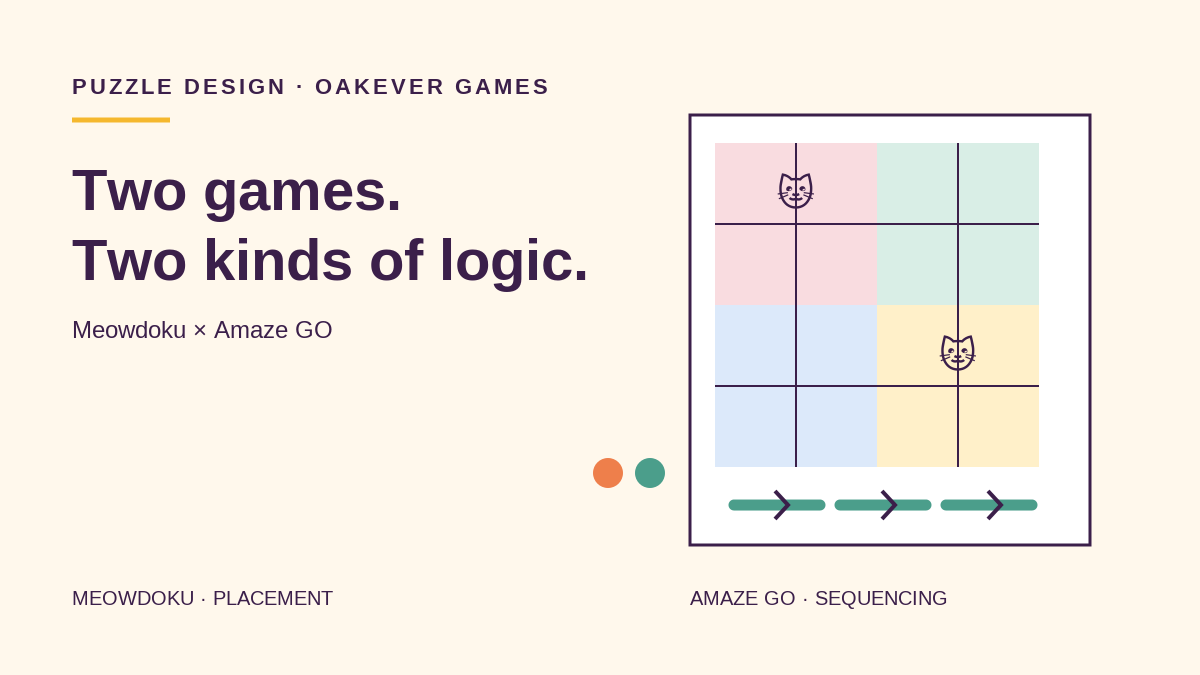
Two Oakever Games puzzle apps appear near the top of the US App Store games chart in the same snapshot: Meowdoku! and Amaze GO!™. They share a studio and a clean logic-first pitch, but ask players to think in different ways. One is about placing cats while respecting intersecting constraints; the other is about removing directional paths in a safe order. We read their chart positions as a useful case study in recognizable rules, distinct decision-making, and presentation that makes a familiar puzzle feel fresh—not proof of a single formula or of why any individual player downloaded either game.
Key takeaways
- Make one decision carry the puzzle: both games can be explained through a small set of constraints, then build depth through their interactions.
- Give a familiar mechanic a clear identity: cats and personal-space rules make Meowdoku legible; arrows and escape paths do similar work for Amaze GO.
- Show consequences before asking for commitment: hearts, path feedback, and guidance help players understand risk.
- Separate engagement tools from the core loop: daily puzzles, events, leaderboards, ads, and subscriptions each have different jobs and costs.
- For a small team, prototype rule clarity first: add content and monetization only when the central decision remains satisfying.
What does the chart snapshot actually show?
Our public snapshot, captured 17 November 2026, lists Meowdoku at #2 in the Games, Casual, and Puzzle charts, while Amaze GO appears at #12 in Games and #8 in Casual and Puzzle, according to the public chart snapshot. Rank claims here mean US App Store, as of 17 Nov 2026. These are positions in a chart at one point in time, not download counts, revenue, long-term retention, or a causal explanation. The underlying listing data identifies Oakever Games as developer for both apps. See the Meowdoku App Store listing and Amaze GO App Store listing.
The contrast is still useful. The two games do not look like reskins of one mechanic. They share a broad promise—short, readable logic play—while giving each title its own visual metaphor and reasoning task. Our related puzzle games mobile trends analysis looks at other ways puzzle games package familiar verbs for mobile audiences.

Meowdoku: combine placement constraints with a soft theme
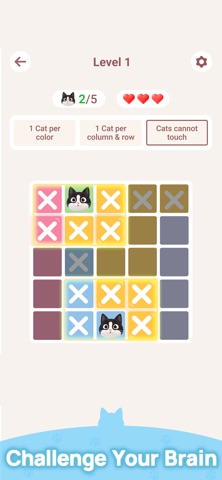
Meowdoku describes itself as a logic puzzle combining Sudoku-style reasoning with Minesweeper-like deduction. Its listed objective is to place one cat in each colored region. Cats cannot share a row or column and cannot touch, including diagonally; a double-tap places one, and the listing says players have three mistakes (hearts) available. That creates a compact loop: inspect the regions, infer candidate squares from the constraints, place a cat, then update what remains possible. Source: Meowdoku listing.
We read the heart limit as a way to make uncertainty visible. A mistake is not only a wrong answer; it spends a finite allowance, so deduction feels consequential. A small studio can test this with a simple question: can a new player explain why a candidate tile is safe before placing it? If not, tutorial examples, clearer region colors, or a hint that reveals a logical implication may help more than an easier level alone.
The listing also describes daily puzzles, offline play, global leaderboards, a themed special event, advertising, and premium subscription options. Its copy characterizes ads as non-intrusive, but that is the publisher’s presentation; we cannot independently verify how often ads appear in every session. The visible US listing includes weekly, monthly, and yearly Premium and Premium Plus purchases. We can verify that offers exist, but the listing alone does not establish exactly which benefits belong to each tier or how much revenue they generate. Treat these as observed store facts, not a complete map of the in-game economy.

Amaze GO: turn order into the main problem
Amaze GO asks players to remove arrows from a crowded grid. The official instructions say to find an arrow with a free path to the edge, tap it to slide away, and plan the order so one cleared route opens another. A wrong tap costs a heart; long-press guidance can highlight directions, and hints are offered for tight grids. So the interesting question is less “where does this piece belong?” and more “which piece can safely leave now, and what will that unlock?” The loop turns sequencing into a visible, tactile action. Source: Amaze GO listing.
This structure can produce a satisfying chain of small reveals. Early moves may be obvious; later moves depend on clearing blockers in the right order. The store page describes a calm presentation and short-session use. Its instructions mention hearts, hints, and guidance, giving the player support while retaining the central sequencing challenge.

The store listing marks the app as containing advertising. Unlike Meowdoku, the listing page we checked does not expose a comparable set of subscription purchase names in the facts captured for this article, so we do not infer that it has a pass or a paid ad-removal tier. One public review complains about frequent ads between short levels; that is an individual player report, not a verified universal schedule. The developer response acknowledges the concern and says ads support ongoing development. For a studio, this is a reminder that ad cadence is part of pacing: if a puzzle takes roughly a minute, an interruption after every board may feel more frequent than the same break after a longer session. The example is feedback to consider, not a measured average.

Two games, two readable forms of friction
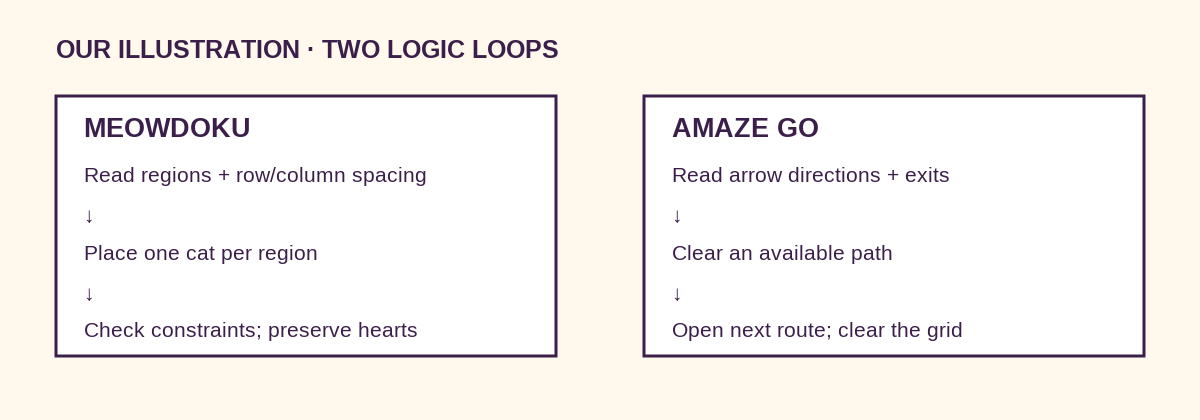
Meowdoku asks players to satisfy simultaneous spatial rules; Amaze GO asks them to find a valid sequence through dependency. Both make failure legible through hearts, but the source of tension differs: a candidate placement may violate a hidden constraint, while an arrow removal may be blocked by another piece. Our illustration summarizes the distinction:
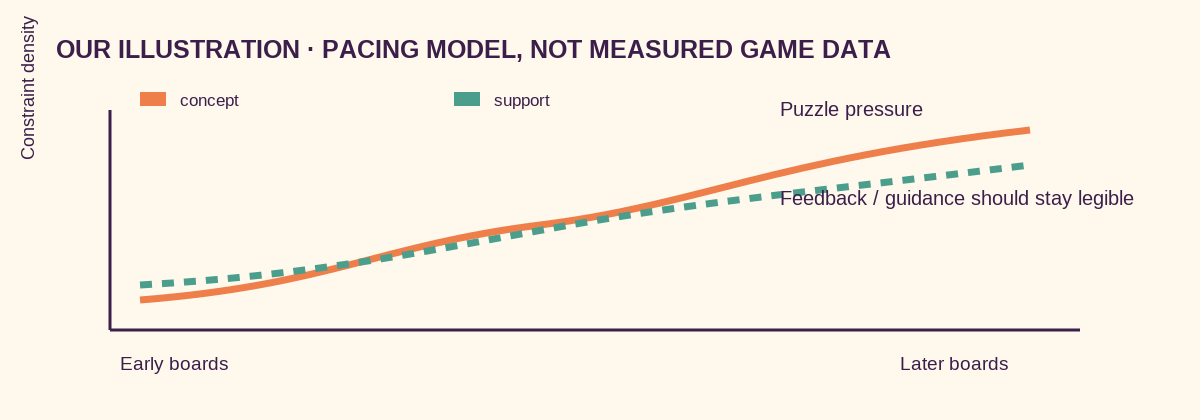
Difficulty design can follow a common principle even when mechanics differ: introduce one source of complexity at a time, then combine known constraints. Our sketch is a proposal for teams, not measured data for either title.
Why might these games chart?
We can observe the chart positions and store presentations; we cannot see the recommendation system, advertising spend, acquisition mix, or player-level behavior from this snapshot. Our best reading is a set of plausible contributors, not a factual account of Oakever’s strategy.
- Low explanation cost: one cat per region and arrows that need a clear exit are easy to understand from a screenshot. That may help a player decide quickly whether the puzzle appeals to them.
- High decision density: both mechanics create consequences from a single move. A placement narrows future options; clearing an arrow changes which paths are open.
- Distinct visual hooks: feline characters and directional arrows signal different fantasies while remaining within familiar puzzle territory.
- Repeatable task framing: daily puzzles, events, and ongoing levels can provide new boards without changing the basic control language.
- Commercial surface area: the listings disclose advertising for both games and subscriptions for Meowdoku. Those models may support continued operation, but store disclosures do not reveal their effectiveness or player acceptance.
Chart rank is an outcome to investigate, not a design recipe. We would not conclude that hearts, subscriptions, ads, or a cute theme caused these positions.
Four practical lessons for small studios
1. Prototype the decision, not the content calendar
Build a handful of boards that demonstrate the mechanic’s full range. For a placement puzzle, test how region shape and adjacency affect deduction. For an arrow puzzle, test how blockers create order dependencies. If the core decision stays interesting, then consider daily boards or themed sets. Our puzzle game design guide covers clarity and feedback principles that support this early work.
2. Teach through consequences
Show why a move works or fails. A brief highlight, a remaining-candidate cue, or a path preview can communicate the rule in context. Hints should preserve player agency: reveal a useful next inference or identify a blocked route rather than silently solve the whole board. Test whether players recover after a mistake, not only whether they finish.
3. Make monetization legible and proportionate
Ads can fund a free puzzle, while subscriptions can bundle ongoing or convenience benefits; each changes the feel of a session. If using interstitials, compare cadence against average level duration and watch exits after ad exposure. If offering a subscription, explain benefits, renewal, and cancellation clearly and ensure the base puzzle still feels complete. Measure player experience alongside revenue. These are recommendations from our analysis, not claims about either game’s internal results.
4. Reuse systems, vary puzzle expression
A daily seed, board generator, or authored level template can create variety while keeping controls stable. Add a special event only when its theme changes the player’s interpretation or goal in a meaningful way. Keep a way to replay or practice without a deadline, so limited-time content does not become the only source of progress.
What we would test next
Closing perspective
Meowdoku and Amaze GO suggest two ways to make logic feel approachable: constrain where a piece can go, or reason about what can leave first. The chart snapshot shows strong US chart positions on one date, while the listings show the mechanics and monetization surfaces players are offered. We read the shared lesson as disciplined focus: give players one clear puzzle question, build depth through consequences, and make help and monetization understandable. For NabiGame Studio, that is a useful benchmark for designing small, replayable games without confusing activity with value.
As of 17 Nov 2026. Chart ranks refer to the US App Store snapshot dated 17 Nov 2026.
Sources
- Apple App Store: Meowdoku! — description, features, ads, purchases, developer.
- Apple App Store: Amaze GO!™ — description, features, ads, developer, reviews.
- Public chart snapshot:
data/top-games/2026-11-17-us.json— ranks and listing metadata captured 17 Nov 2026.
Comments
Loading comments…