
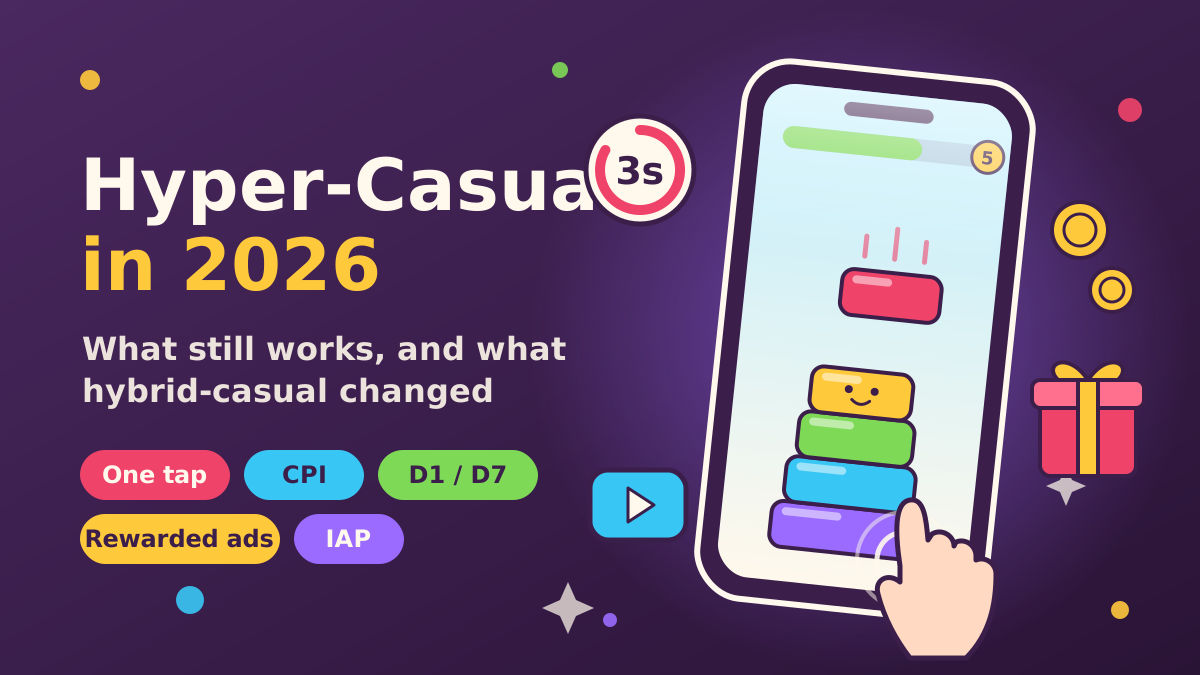
Hyper-casual games are free mobile games built around a single, instantly understandable mechanic, usually one tap or one swipe, that anyone can play within seconds and without a tutorial. They are designed for very short sessions, are cheap to produce, and have traditionally earned most of their money from ads. Since about 2022 the genre has been shifting toward hybrid-casual: the same easy hook, with deeper progression and a mix of ads and in-app purchases on top.
Key takeaways
- The hyper-casual recipe (one-tap mechanic, instant hook, short sessions) still works for acquiring players.
- Rising acquisition costs pushed publishers toward hybrid-casual games that keep players for weeks, not days.
- Test marketability with a cheap prototype and a CPI test before building content.
- Retention (D1, D7) and playtime predict lifetime value (LTV). Always read benchmarks with their year.
- In hybrid-casual, rewarded ads and IAP do the heavy lifting; interstitials belong only at natural breaks.
What is a hyper-casual game?
A hyper-casual game is a mobile game where the whole game is the core mechanic: stack the block, time the jump, roll the ball through a gap. There is no story and no long onboarding. You understand it from a five-second video ad and are playing seconds after install.
GameAnalytics sums up the design brief neatly in its write-up of hyper-casual benchmarks:
“Short, so someone can play your game while standing in a queue. Simple, so anyone can start playing without any instructions.”
— Sean Parmenter, GameAnalytics, “The Metrics Behind Hyper-Casual Games”
The same article sorts the genre into timing (Crossy Road, Color Switch), traversal, physics (Helix Jump) and shooting sub-genres. The novelty is usually in the theme and the satisfying moment, not in a brand-new verb.
How did hyper-casual shift toward hybrid-casual?
An ironSource article from January 2024 says hyper-casual went from relatively unknown to 40% of the total share of voice for games, and still reached 1.7B installs and $2-2.5B in revenue per year. It also notes that eCPMs and LTVs had started to decline due to new regulations, app store policies and macroeconomic conditions (ironSource / Unity blog, 2024).
In a December 2024 interview, Supersonic's Samantha Benjamin dated the decline to 2022-2023, citing rising user acquisition costs and diminishing eCPMs, while noting hyper-casual still accounts for around a third of mobile gaming ad impressions (Unity blog, 2024). Her definition of what came next is the clearest we have found:
“At Supersonic, we see hybrid-casual games as a combination of the mass appeal and marketability of hyper-casual games with the deeper, more engaging gameplay and content usually affiliated with casual games.”
— Samantha Benjamin, Director of Growth and LiveOps at Supersonic, Unity blog
Publishers felt the same pressure. Homa cofounder Olivier Le Bas told mobilegamer.biz in 2023 that, before Apple's ATT changes, Homa released games expecting under 10% day-seven retention, and was now aiming for something like 15% and above (mobilegamer.biz, 2023). His summary:
“The standards are higher, expectations in terms of real quality and longevity of the experience are higher.”
— Olivier Le Bas, cofounder of Homa, mobilegamer.biz
The money followed. Sensor Tower's State of Mobile Gaming 2025 reports that hybridcasual games saw a 37% increase in in-app purchase revenue year over year in 2024, while total game downloads fell 7% to 49 billion (Sensor Tower, 2025). Fewer installs and more spending per player favors games that keep players around.
Hyper-casual vs hybrid-casual vs casual: a quick comparison
- Hyper-casual: one mechanic, minimal meta, sessions of a minute or two. Monetized mostly through interstitial and banner ads. Short development cycles measured in weeks. Wins on marketability and CPI.
- Hybrid-casual: the same instantly readable hook, plus progression, upgrades, collections or light idle systems. The ironSource piece says hybrid games get 45% more rewarded video impressions and generate 20-50% of their revenue from IAP, with development usually taking 9-12 months; Supersonic's Benjamin quotes around 12-18 months from concept to launch. Wins on retention and LTV.
- Casual (match-3, merge, puzzle sagas, decoration games): deeper economies, live ops, events and a much larger content pipeline. Mostly IAP-driven, often with rewarded ads. Wins on long-term engagement, but costs much more to build and to market.
In our experience at NabiGame Studio, the line between these categories is blurry in practice. Our merge puzzle Juice Fruit and our block puzzle Crystal Drop both start with a hyper-casual-style hook (drop, merge, clear) but rely on puzzle depth to bring players back. We think that is the useful way to read "hybrid-casual": not a genre label, but a direction of travel.

How do you design a hyper-casual core loop?
The core loop is the action the player repeats every few seconds, and in hyper-casual it carries the entire game. Five principles we rely on:
- One input. Tap, hold, or swipe. If you need to explain the controls, the mechanic is probably too complex. Our bubble shooter Bubble Fall works because "aim and shoot" is obvious the moment you see it.
- A three-second hook. Within the first few seconds the player should do the core action and see a satisfying result. Those seconds are also your video ad, so design them together.
- Visible progress. A bar filling, a tower growing, a board clearing.
- Forgiving failure. GameAnalytics advises not making the game too tricky and offering multiple lives or rewards. Fast restarts beat harsh difficulty.
- Juice. Squash and stretch, particles, screen shake and sound turn a simple action into a satisfying one. We wrote about the techniques behind this in our devlogs on trails and particle effects and parallax and platformer game feel.
Our opinion: the "one-tap" rule is less about the number of buttons and more about the number of decisions. A good hyper-casual loop asks the player exactly one question at a time (now or later? left or right?) and answers it instantly.
How do you test a hyper-casual prototype?
The classic publisher process is: build a small playable prototype in days, make a handful of short video ads from it, buy a small amount of traffic, and measure. The key number is CPI, cost per install. Supersonic's publishing blog explains why:
“A low CPI is confirmation that many users understand and enjoy your game - and that your game can scale affordably.”
— Supersonic, “The 3 most important KPIs for testing your hyper-casual prototype” (2021)
That 2021 article recommended a CPI under $0.30, D1 retention of 38% or higher on Android, and average playtime over the first seven days (APPU D7) above 2,000 seconds, plus watching IPM (installs per thousand impressions) on SDK networks. Treat these as historical reference points: UA costs have risen since, and targets depend on genre, platform and country.
Thresholds are also not gospel. Voodoo wrote in 2020 that it had lowered its own launch KPIs from 55% D1, 22% D7 and CPI below $0.25 to 45% D1, 13% D7 and $0.20 CPI, after seeing that some of its biggest hits, such as Woodturning 3D, would not have been launched under the old rules (GameAnalytics, republished from Voodoo).
“By acknowledging that retention and CPI are only part of the picture, we have reached many more players worldwide.”
— Youssef Gasmi, Communications Manager at Voodoo, GameAnalytics blog
For hybrid-casual prototypes the test is wider. Supersonic's Benjamin lists a good CPI-to-LTV ratio, healthy IAP conversion, Day 7 retention, session length and playtime, and a monetization mix where ads and IAP do not cannibalize each other (Unity blog, 2024).
What we do as a small studio: before spending on ads, we test the "ad moment" internally. If we cannot cut a 10-second clip of the prototype that makes someone on the team say "wait, let me try", the idea is unlikely to win a CPI test either.
Retention and LTV: what do D1 and D7 actually tell you?
D1 retention is the share of new players who return the day after install; it mostly measures whether the core loop is fun. D7 retention measures whether there is a reason to keep coming back, which is where meta systems earn their keep. LTV (lifetime value) is the revenue an average player generates; a game only scales if LTV is comfortably above CPI.
GameAnalytics' hyper-casual report, using 2020-era data from the top 5% of games, found that D1 retention was around 40% across sub-genres (44% for timing games) and D7 retention was mostly just below 15% (17% for shooting games). It also warned that any hyper-casual game with a D1 below 40% probably isn't doing well (GameAnalytics).
Hybrid-casual raises the time horizon. The ironSource article describes hybrid-casual content as built to last:
“Hybrid-casual gameplay is still simple, but the quantity and quality of content are optimized for longer playtimes, aiming to keep players playing up to D60 and beyond.”
— ironSource content team, Unity / ironSource blog
Our view: for a puzzle game, D1 is about the first ten minutes and D7 is about the first ten hours. If your levels run out, or your difficulty curve flattens, D7 will tell you long before revenue does.
Rewarded ads, interstitials or IAP?
Hyper-casual games historically leaned on interstitials (full-screen ads between levels) and banners. The ironSource article notes that hybrid-casual shifts the emphasis toward rewarded videos and playables.
Unity's Game Design & Revenue Consultancy reaches a similar conclusion from the IAP side. Its 2025 guidance is to implement rewarded ads before system-initiated ads like interstitials, and it notes that only 1-3% of daily active users engage in IAPs, citing Unity's 2024 Mobile Growth and Monetization Report (Unity blog, 2025). On placement, the advice is blunt:
“For system-initiated ads, ads should also complement, not interrupt, the existing core gameplay loop.”
— Daniel Godley, summarizing Unity’s Game Design & Revenue Consultancy, Unity blog
A practical split that follows from these sources:
- Rewarded ads: opt-in, for continues, extra moves, double coins or a free booster. Players choose them, so they hurt the experience least.
- Interstitials: only at natural breaks such as the end of a level, with frequency caps. Never mid-move.
- IAP: remove-ads, starter packs, boosters, cosmetics. Calibrate rewards so rewarded ads do not make IAP pointless, and vice versa.
From our own puzzle work, including Block Puzzle Master 2020, our principle is simple: an ad should feel like a choice the player made or a pause they expected. If it feels like a punishment, it will cost you retention.
Common hyper-casual mistakes
- Polishing before testing. Test the hook first.
- A tutorial that explains the hook. If the mechanic needs words, simplify the mechanic.
- Copying KPI thresholds without dates. A 2020 CPI target says little about 2026 auction prices.
- Bolting on meta after launch. Hybrid-casual progression works best when it is designed around the core loop from the start.
- Ignoring game feel. In a one-mechanic game, feedback quality is the content.
A practical hyper-casual and hybrid-casual checklist
- Can you describe the core action in five words or fewer?
- Does a new player perform it, and see a satisfying result, within about three seconds?
- Can you cut a 10-15 second ad from raw gameplay that is understandable with the sound off?
- Have you run a small CPI or marketability test before building content?
- Do you know your D1, D7 and average playtime, and how they compare with dated, genre-specific benchmarks?
- Is there a reason to return on day 7 (progression, collections, daily challenges)?
- Are rewarded ads opt-in and useful, interstitials limited to natural breaks, and IAP not cannibalized by ads?
- Do you have a kill rule, a point where you stop iterating and move to the next prototype?
If you are building a casual or hybrid-casual game and need help with development, polish, or porting between iOS, Android and the web, take a look at our game development services.
Have a puzzle or arcade idea you want to prototype, or a game you want to bring to more platforms? We would love to hear about it: get in touch with NabiGame Studio.
FAQ
What is the difference between hyper-casual and hybrid-casual games?
Hyper-casual games are built around one simple mechanic with minimal progression and mostly ad-based revenue. Hybrid-casual games keep that easy-to-learn hook but add deeper progression, meta systems and an economy, so players stay for weeks. They also earn a meaningful share of revenue from in-app purchases; an ironSource article from 2024 puts it at 20-50%.
Are hyper-casual games still profitable in 2026?
Some still are, but the pure ad-funded model has become harder since about 2022 because user acquisition costs rose and ad revenue per user fell. Most large publishers now favor hybrid-casual designs, with hyper-casual mechanics serving as the hook.
What is a good CPI for a hyper-casual prototype?
There is no universal number, because CPI depends on country, platform, ad network and year. As a historical reference, Supersonic suggested aiming under $0.30 in 2021, and Voodoo used $0.20 as a launch threshold in 2020. Today, judge CPI against your expected LTV rather than a fixed target.
What D1 and D7 retention should a hyper-casual game have?
Benchmarks vary by genre and have changed over time. Using 2020-era data, GameAnalytics found the top 5% of hyper-casual games around 40-44% D1 and roughly 15-17% D7, and Homa said in 2023 that it aims for roughly 15% or more at day seven. Compare against recent, genre-specific data where you can.
Should a hybrid-casual game use rewarded ads or interstitials?
Start with rewarded ads, because they are opt-in and add value for the player. Add interstitials carefully, only at natural breaks such as level ends, with frequency caps and testing.
How long does it take to make a hybrid-casual game?
Much longer than a hyper-casual prototype. An ironSource article from 2024 says hybrid-casual development usually takes 9-12 months, and Supersonic's Samantha Benjamin cited around 12-18 months from concept to launch.
Sources
- Unity blog: Mobile Gaming’s Shift from Hyper to Hybrid-Casual Games (interview with Samantha Benjamin, Supersonic), December 2024
- Unity / ironSource blog: The shift from hyper to hybrid-casual games, January 2024
- Unity blog: From IAP to hybrid monetization, May 2025
- Sensor Tower: State of Mobile Gaming 2025, March 2025
- mobilegamer.biz: Hypercasual isn’t dead for Attack Hole maker Homa, August 2023
- Supersonic: The 3 most important KPIs for testing your hyper-casual prototype, August 2021
- GameAnalytics: How Voodoo Diversified and Lowered Game Product KPIs (originally 2020)
- GameAnalytics: The Metrics Behind Hyper-Casual Games (2020-era data)
Comments
Loading comments…