
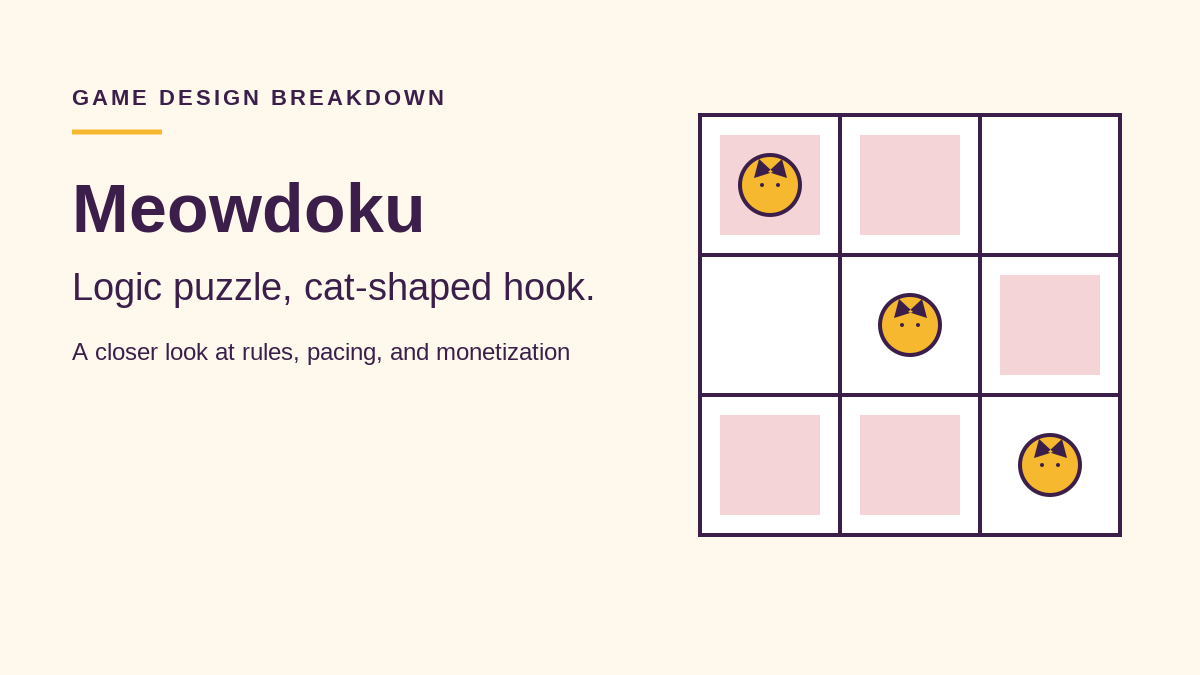
Meowdoku! turns a familiar logic challenge into a compact cat-placement puzzle: find a legal home for every cat while respecting colored regions, rows, columns, and neighboring squares. In our snapshot, it sits at rank 2 in the Games, Casual, and Puzzle charts (US App Store, as of 17 Nov 2026). That is a strong chart position, not proof of why it earned it. Our read is that a legible ruleset, appealing theme, short solving loop, and visible promotion may combine into an unusually easy pitch to understand and share.
This is a design and monetization breakdown, not a claim to know Oakever Games’ internal strategy. We use the public App Store listing, Google Play listing, and our dated chart snapshot; mechanics and commercial outcomes can change by platform, region, and version.
At a glance
- What it is: a single-player logic game built around placing cats in colored territories under row, column, and adjacency constraints.
- Why it stands out: familiar deduction structure gets a friendly visual identity and a clear one-sentence premise.
- How it is sold: the US App Store lists it as free, with advertising and in-app purchases, including Premium and Premium Plus subscriptions.
- What the chart says: rank 2 in Games, Casual, and Puzzle charts (US App Store, as of 17 Nov 2026).
- Our main caveat: rankings show relative storefront position at one snapshot. They do not disclose downloads, revenue, retention, paid acquisition, or causal drivers.
What does Meowdoku ask you to do?
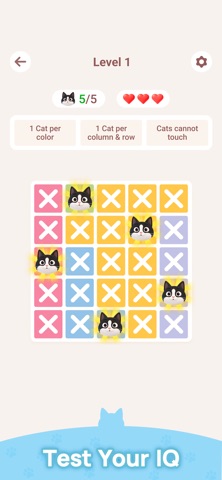
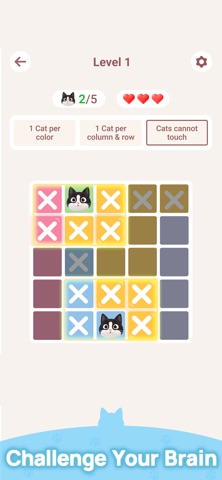
The store listing describes a board divided into colored sections. The player places exactly one cat in each section; cats cannot share a row or column, and cannot touch, including diagonally. A double-tap places a cat, while the listing describes three hearts as the mistake allowance. This combines familiar constraint-based placement with a small risk layer: an uncertain choice can cost a life, so deduction matters more than speed. These mechanics are described on the Google Play listing; the precise presentation can differ between versions.

The hook sits in the overlap between recognizable rules and a small twist. Sudoku gives players a frame for rows and columns; the color territories and no-touch rule add new constraints; cats make the board feel less like a worksheet. Our interpretation is that onboarding can lean on visual demonstration instead of a long tutorial. One example move can show “one per color, one per row and column, no neighbors” faster than a paragraph of rules.
That clarity also sets a high bar. When a player loses a heart, the reason needs to be obvious: which rule did that placement break? If adjacency includes diagonals, the board should communicate that consistently. Error feedback is part of the puzzle language, not just punishment. Our puzzle game design guide covers this broader principle: readable goals and understandable feedback are foundations of satisfying difficulty.
Why might it be charting?
Here is what the snapshot supports: Meowdoku! (App ID 6761760135) ranked #2 in each of the Games, Casual, and Puzzle charts (US App Store, as of 17 Nov 2026). The app record lists Oakever Games as developer, a May 2026 release date, and 441,611 ratings at capture. The same record marks the app free. Apple’s live listing showed 442K ratings and 4.8 when checked. Ratings are not a download count; neither is the chart rank a revenue estimate.
We read the position as a promising signal that the presentation and product have broad appeal, but this is inference. Several plausible ingredients may work together:
- Fast comprehension: a grid and colored regions are familiar visual grammar. A new player can understand the broad task before learning every edge case.
- Distinctive theme: cats add warmth and memorability to an abstract logic challenge. A recognizable theme can help a store tile or short video earn attention, though this snapshot cannot tell us which creatives performed.
- Useful tension: the hearts rule can make a move feel consequential. It may turn a quiet placement puzzle into a sequence of small decisions. If errors feel arbitrary, that tension can become frustration instead.
- Broad category fit: the snapshot places it high across Games, Casual, and Puzzle. Those category placements make it visible to several browsing intents; they do not tell us which source drove installs.
- Frequent updates: the listing’s version history shows repeated updates through November 2026. This is evidence of release activity, not proof that update cadence caused chart performance.
Prominent paid promotion, word of mouth, store featuring, and improved conversion are all possible contributors, but we cannot verify their roles from public rank data. A chart is an outcome, not an attribution report. Teams should resist turning one successful snapshot into a universal formula.
Difficulty and pacing: where the design earns trust
Constraint puzzles offer a natural way to pace challenge. Early boards can teach one rule at a time; later boards can combine constraints, reduce obvious placements, or ask players to reason several moves ahead. That progression is a design opportunity, not a verified description of Meowdoku’s level curve. The public listings do not publish level-by-level difficulty data, and we avoid claiming a specific curve or level count.
A strong puzzle teaches through play, then lets the player notice a pattern before it tells them the answer. The three-heart framing described by Google Play gives mistakes a clear cost. That can support concentration, but it also makes clarity crucial. If the game accepts a guess and only later reveals a contradiction, players need to understand whether the heart represents an incorrect move, a failed board, or a limited retry. A generous undo or explanation can turn an error into learning; an opaque penalty only teaches caution.
The App Store listing says the app contains advertising, while Google Play’s current description says ads do not interrupt gameplay. These are publisher-provided descriptions, not independent verification of every ad placement or player experience. The distinction matters: “non-intrusive” is an intended promise, but players experience concrete timing, frequency, loading, and reward behavior. A puzzle’s rhythm makes interruptions especially noticeable after a concentrated solve.

Monetization: free entry, ads, and recurring purchases
The US App Store listing describes Meowdoku! as free, says it contains advertising, and lists in-app purchases. The purchases include weekly, monthly, and yearly Premium and Premium Plus subscriptions, at displayed US prices ranging from $3.99 to $69.99. Price points and availability may change; check the live listing for current terms. We can verify the offer structure, but the listing does not explain every entitlement or whether a given tier removes ads.
This visible mix creates several possible design jobs: free access can lower the first-play barrier; advertising can monetize players who do not subscribe; and subscriptions can offer recurring value to a subset of engaged players. That is a plausible model interpretation, not a statement about actual revenue split, conversion, or profitability. The publicly visible page does not provide those numbers.
For a logic game, monetization should respect the player’s mental flow. If an ad interrupts after every short board, it can make a satisfying finish feel like a transaction. If an optional ad offers a clearly explained hint or retry, the player can choose whether that trade suits them. A subscription can feel worthwhile when benefits are explicit and sustained; vague premium tiers risk confusing the very people who might pay. Our recommendation is to make the free loop complete and the paid value concrete, then inspect ad timing as carefully as puzzle difficulty.
There is a useful design tension here: a mistake limit may heighten stakes, while monetization near failure can make those stakes feel engineered. A small studio should test whether players understand why they are being offered a purchase or ad, whether declining leaves them with a fair path forward, and whether the offer appears at a natural pause. Do not infer that Meowdoku uses a particular pressure tactic from the public store data; these are questions for any team designing a similar economy.

Four takeaways for a small studio
- Make the premise demonstrable. Prototype a one-screen tutorial that teaches the core constraints with a move, a highlight, and clear feedback. Ask a first-time player to explain the goal back to you. If they cannot, simplify language or board presentation before adding content.
- Use theme to improve readability. A theme should help players identify states and celebrate outcomes, not obscure important distinctions. Check color contrast, labels, and non-color cues. Cute art can earn the first tap; legible feedback earns the next session.
- Build difficulty from reusable rules. Track which constraint each level introduces and which combinations it tests. Review solve paths and ambiguous states. Variation from recombining a small rule set can be more sustainable than constantly inventing mechanics.
- Protect the pause after a solve. Measure board completion, next-board starts, hint use, exits, and ad exposure around the same moments. Test ad frequency and subscription messaging against satisfaction guardrails, not revenue alone. Preserve an uninterrupted route for players who want a focused session.
Our broader takeaway: a strong casual puzzle can be easy to describe and still reward careful thinking. The craft sits in the relationship between the rules, the feedback, the pacing, and the business model. A familiar board does not guarantee success; execution and distribution both matter, and public data cannot isolate their effects here.
Sources
- Meowdoku! — US App Store listing (developer, ratings display, advertising and IAP disclosure, subscription options, version history, screenshots).
- Meowdoku: Brain Puzzle Games — Google Play listing (published rules and feature claims).
- NabiGame top-games snapshot, US, 17 Nov 2026 (chart ranks and app metadata).
- NabiGame: Puzzle Game Design Guide (related design principles).
As of 17 Nov 2026. Rank claims refer to the US App Store chart snapshot captured on that date. Store details may change after publication.
Comments
Loading comments…