
Bus Traffic Fever! takes a familiar traffic jam and adds color sorting, limited staging space, and a stream of passengers. The premise is immediately readable: dispatch buses, match passengers to them, and clear congestion. The harder question is whether each move leaves enough room for the next one. We read its chart position as evidence that this theme-and-loop combination has broad appeal, not proof of why any individual downloaded it.
What is Bus Traffic Fever?
GOODROID, Inc.’s App Store listing describes a parking and color-sorting puzzle in which players move buses to collect matching passengers. The current public listing identifies it as free with in-app purchases, advertises it under Puzzle, and shows a season pass among its purchase options. Its Google Play listing calls it a single-player logic puzzle. Those are store facts; the strategic interpretation below is ours.
“Move, park, and collect—every decision matters”
— GOODROID, App Store listing
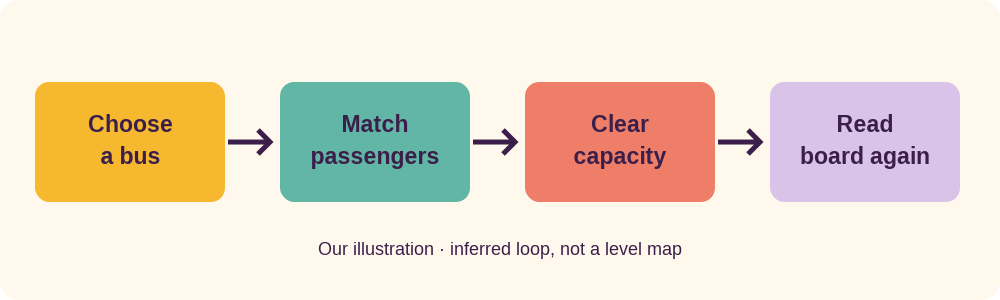
That short promise is an effective explanation of the interaction: choose a bus, send it into a constrained board, and let matching passengers board. Clearing a bus or freeing a position changes what can be attempted next. A move can therefore make immediate progress while also occupying scarce space. The player’s job is not simply to find a matching color; it is to preserve a workable sequence.


Why does the loop feel compelling?
We see three design strengths in this structure. First, the goal is concrete and visual: match colors, fill buses, clear the scene. Second, the board makes consequences visible. A parked bus consumes a slot, while a passenger group waiting on the route hints at future demand. Third, the player can reason in short steps. They do not need to plan a whole campaign to understand whether a move creates or removes options.
This is a useful “read, act, resolve, reread” rhythm. A move sets off visible passenger movement, then the player scans the changed layout. Small actions produce feedback quickly, while the capacity limit makes careless choices matter. Our reading is that the loop combines the satisfaction of sorting with the tension of traffic management: the same move can be both progress and a commitment.
Difficulty and pacing: pressure without opacity
In this puzzle family, a gentle opening can teach one rule at a time: match a bus to a passenger color, then notice the cost of occupying a slot. Later boards can add more colors, less convenient ordering, or fewer safe staging choices. These are design levers we infer from the core loop, not a verified level-by-level account of this game.
The strongest ramp makes the player think one move further, then gives a quick opportunity to recover or learn. Too many colors introduced together can turn a clean matching task into visual search. Too little slack can make a level feel predetermined. For a small studio, we would review each difficulty step with a simple question: can a new player explain why their last move helped or hurt?
The store listing displays a season pass and several purchase categories, but does not explain the pass’s exact progression rules or how its events operate. We therefore avoid treating a particular event calendar or long-term meta as established fact. A pass suggests an additional progression layer is offered; its value depends on the actual rewards, pacing, and clarity players experience in the current build.
Monetization: what public listings confirm
Apple’s listing says the game is free and includes in-app purchases. It currently shows coin products, booster and bundle options, a “NoAds pack,” a “Fail Offer,” and a “Season Pass_11.” Google Play marks the game as containing ads and in-app purchases. These listings confirm monetization categories, not how often ads appear, whether any specific ad is mandatory, or how a purchase changes a particular level.
That distinction matters. Store reviews include differing player accounts about ads and level difficulty. Reviews are individual experiences, not controlled evidence about the whole audience or the developer’s intent. We read them as a reminder that monetization is part of perceived difficulty: if a player cannot tell whether a failure came from their planning or from an unclear system, trust can erode even when the core puzzle is enjoyable.
A healthier design test is to keep the no-purchase path understandable and to make optional offers legible. If an ad grants extra space, explain what it does before the player commits. If a fail offer appears, ensure that the player can distinguish retrying through skill from continuing through a purchase. A no-ads option should communicate its scope plainly. These are recommendations, not claims about the current implementation.
Why might it chart?
In our supplied snapshot, Bus Traffic Fever! appears at #6 in Games, #5 in Casual, and #5 in Puzzle. Label for each rank: US App Store, as of 17 Nov 2026. The snapshot identifies GOODROID, Inc., a March 2026 release date, a 4.70514 rating and 92,024 ratings. These are point-in-time store and chart signals, not download or revenue estimates.
Our read is that the concept is easy to understand from a screenshot or short video: colored people, matching buses, a jammed route, and a visible clearing goal. The theme also makes familiar puzzle rules feel like a physical scene rather than abstract tiles. Combined with immediate taps and short feedback cycles, that clarity could help the game travel through store browsing and word of mouth. We cannot attribute the chart position to any single factor from this snapshot.
Four practical takeaways for small studios
- Show the constraint in the first minute. Teach matching and limited capacity together. A tutorial that explains colors but hides the slot trade-off teaches only half the game.
- Make every move explain itself. Animate who boards, what space opens, and why the next choice changed. Players should be able to diagnose a mistake without guessing at hidden rules.
- Build difficulty from sequencing. Add one source of pressure at a time, then test whether players can name a viable next move. More colors or tighter capacity are not automatically better challenge.
- Keep monetization outside the logic test. Offers and rewarded ads should not obscure whether a puzzle is solvable through play. Track retries, ad prompts, quits, and level completion together; a revenue lift alone cannot tell whether friction stayed fair.
These lessons connect with our analysis of the broader bus and traffic-jam puzzle pattern and our puzzle game design guide. The former considers a category-level pattern; this article stays with one game and treats its chart snapshot as a dated signal.
Our conclusion
Bus Traffic Fever! pairs readable color matching with a spatial sequencing problem. That gives a simple premise room for meaningful decisions: a bus that looks useful now may occupy the position needed for a better match later. We read its chart presence as a plausible fit between instantly communicable play and layered choices, while keeping that explanation provisional. For teams studying it, the most transferable craft lesson is to make constraints visible, feedback clear, and monetization easy to distinguish from puzzle logic.
As of 17 Nov 2026: chart ranks and app metadata in this article refer to the supplied public US snapshot. Store listings can change.
Sources
- Apple App Store listing: Bus Traffic Fever! — description, category, developer, rating snapshot, and purchase categories.
- Google Play listing: Bus Traffic Fever! — puzzle description and ad/IAP labels.
data/top-games/2026-11-17-us.json— public chart and app metadata snapshot used for rank claims.


Comments
Loading comments…