
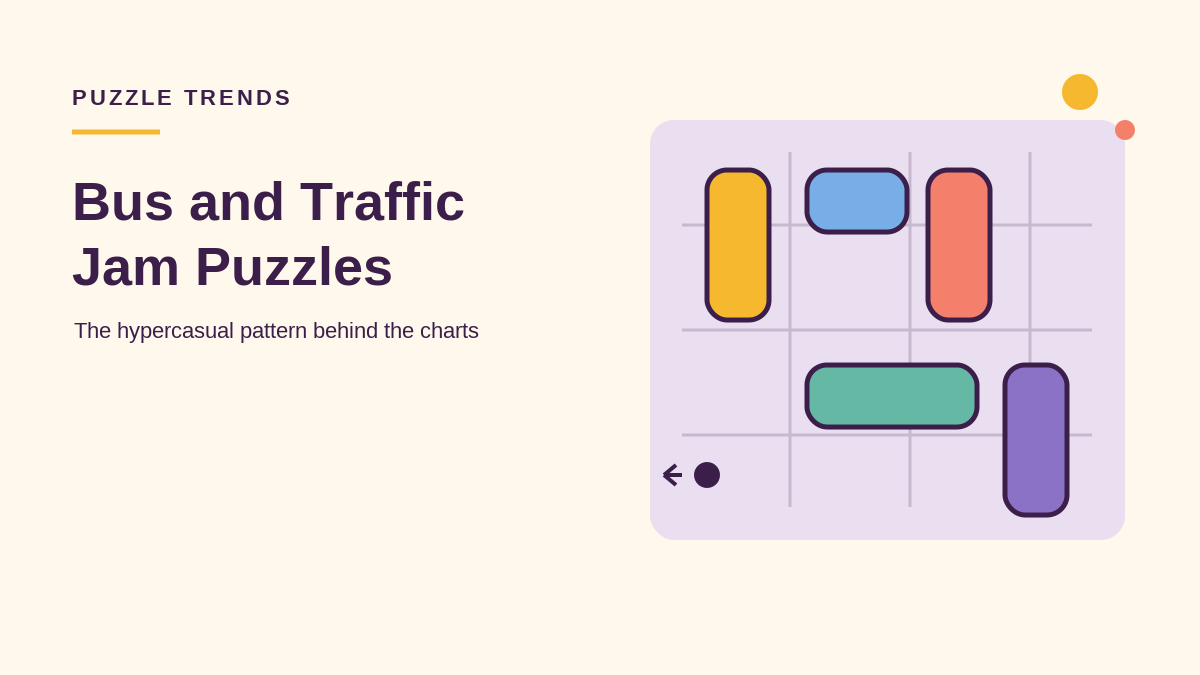
Bus and traffic-jam puzzles turn a familiar frustration into a tidy logic problem: vehicles block one another, passengers or parking spaces impose a second constraint, and each tap should make the board easier to read. In the US App Store snapshot dated 17 November 2026, three related games appeared in the charts: Bus Fever Party! and Bus Traffic Fever! in both Casual and Puzzle, and Parking Loop in Puzzle. That is a useful signal of a recognizable pattern, not proof of sales, profitability, or a single cause.
Key takeaways
- Make the board legible first: players should see blockers, destinations, and limited capacity at a glance.
- Layer constraints gradually: add one new rule at a time, then combine rules after players understand them.
- Use friction honestly: rewarded ads and purchases can support a free game, but avoid making routine progress feel artificially blocked.
- Build replay from the puzzle: level variety and clear mastery goals can do more than a heavy meta layer.
- Study the pattern, not the clone: transport is a theme; the reusable design is constrained sequencing with visible consequences.
What do the chart entries tell us?
The snapshot records Bus Fever Party! by Lumi Games at #5 Games, #4 Casual, and #4 Puzzle; Bus Traffic Fever! by GOODROID, Inc. at #6 Games, #5 Casual, and #5 Puzzle; and Parking Loop by Loop Games at #14 Puzzle. These are US App Store, as of 17 Nov 2026 positions from one public snapshot. Rankings move, and a chart position does not disclose downloads, revenue, acquisition spend, or retention. The pattern we read is that sorting, parking, and traffic logic currently have enough store visibility to merit close design study.
How does the core loop work?
Bus Fever Party!: clear space, match, load
The App Store listing describes tapping buses to open space, matching passengers to buses by color, and clearing the parking lot. That gives the player a short chain of decisions: identify which vehicle can move, preserve enough room, then select an order that lets the right passengers board. The board teaches its own state through colored groups and blocked paths.

Its listing also mentions obstacles and boosters. We read that as a familiar difficulty ladder: early boards can teach movement and matching separately; later boards can combine more blockers, tighter staging capacity, and special cases. The store page says “hundreds” of puzzles, but does not document an exact campaign structure or level curve, so we avoid assuming how often rules change.

The listing reports advertising and in-app purchases, including coin packs, bundles, and ad-free options. It also names an “Ad-Free Pass.” That supports saying monetization includes ads and optional purchases; it does not establish how frequently ads appear in play or whether a pass is time-limited. The design lesson is to show what an ad or purchase changes, especially when it grants a recovery slot or booster, and to ensure a sound solution remains discoverable without payment.
Bus Traffic Fever!: translate congestion into color sorting
GOODROID’s listing frames its game as parking plus color sorting: move vehicles, clear lot congestion, and collect passengers. The same broad ingredients are rearranged into a loop of freeing a path, making a color-compatible pickup possible, and avoiding a state where available spaces run out.

The board is compelling because planning is visual. A vehicle is both a movable blocker and a possible solution. We infer that pacing can come from increasing the number of interacting pieces and making the order of moves matter more; the listing itself does not specify an exact progression or meta system. It advertises in-app purchases and is free to download, but the public listing material we reviewed did not expose a complete purchase catalog. We therefore make no claim about passes, specific booster prices, or ad frequency.

Parking Loop: same spatial appeal, different wrapper
Parking Loop shifts emphasis from bus-passenger matching to putting objects in the right place while avoiding a dead end. Its listing describes careful planning, increasingly tricky levels, and hundreds of puzzles. We include it as a neighboring example of the spatial-constraint pattern, not as a bus game.

The store page indicates advertising and in-app purchases, including coin packs, bundles, and remove-ads options. Those catalog entries describe available offers, not their value or how central they are to progression. For designers, the useful comparison is how little narrative explanation a clear spatial board needs: the player can understand the objective by seeing where pieces fit and what blocks them.

Why might this pattern chart?
Our reading is a hypothesis built from the visible store presentation and chart snapshot. First, the premise needs little explanation: most players recognize a traffic jam and can predict what “make space” means. Second, each move has immediate visual feedback, which makes a short session feel complete even when the larger campaign continues. Third, congestion naturally produces an “aha” moment: a move that looks unhelpful can unlock several later moves.
Fourth, the theme accommodates variation without changing the basic control vocabulary. Color matching, seat capacity, one-way paths, special vehicles, or temporary obstacles can change planning while taps and drags remain familiar. Finally, store screenshots can demonstrate the dilemma in a single frame. These are plausible advantages, not verified explanations for the ranks. The snapshot cannot tell us whether chart movement came from paid marketing, featuring, seasonal timing, creative testing, or organic sharing.
What can a small studio apply?
- Prototype a one-screen puzzle. Use a small board, a few vehicle shapes, and one capacity limit. Test whether players can explain why a move is legal and what it will unblock before adding progression.
- Teach through safe combinations. Introduce movement, matching, and capacity separately. Then combine two rules in a forgiving level. Track wrong moves and restarts in playtests; don’t equate failure with difficulty quality.
- Make difficulty auditable. Label each level by blocker count, decision depth, and special rules. Create a gentle ramp with occasional relief levels. This makes tuning more precise than relying on a vague “harder” label.
- Give the meta a job. A map, collection, or light decoration layer can reward completion, but should not obscure the next puzzle or require a separate economy before the core loop works.
- Set monetization guardrails. Offer optional rewarded recovery after a genuine mistake, and make paid removal of forced ads explicit. Test solvability without boosts. Treat a pass as a later experiment only if the content cadence supports it.
For more on clear rules, feedback, and a manageable difficulty curve, see our puzzle game design guide. At NabiGame Studio, we would borrow the clarity of the traffic metaphor, then build a distinct mechanic or world around it. For example, Crystal Drop uses a different spatial-planning loop: sliding gem bars and clearing rows. The point is to identify a satisfying decision structure, not reproduce another studio’s presentation.
Sources
- Bus Fever Party! App Store listing
- Bus Traffic Fever! App Store listing
- Parking Loop App Store listing
- NabiGame public chart snapshot (17 Nov 2026)
As of 17 Nov 2026. Chart positions reflect one US App Store snapshot; store features and offers may change.
Comments
Loading comments…