
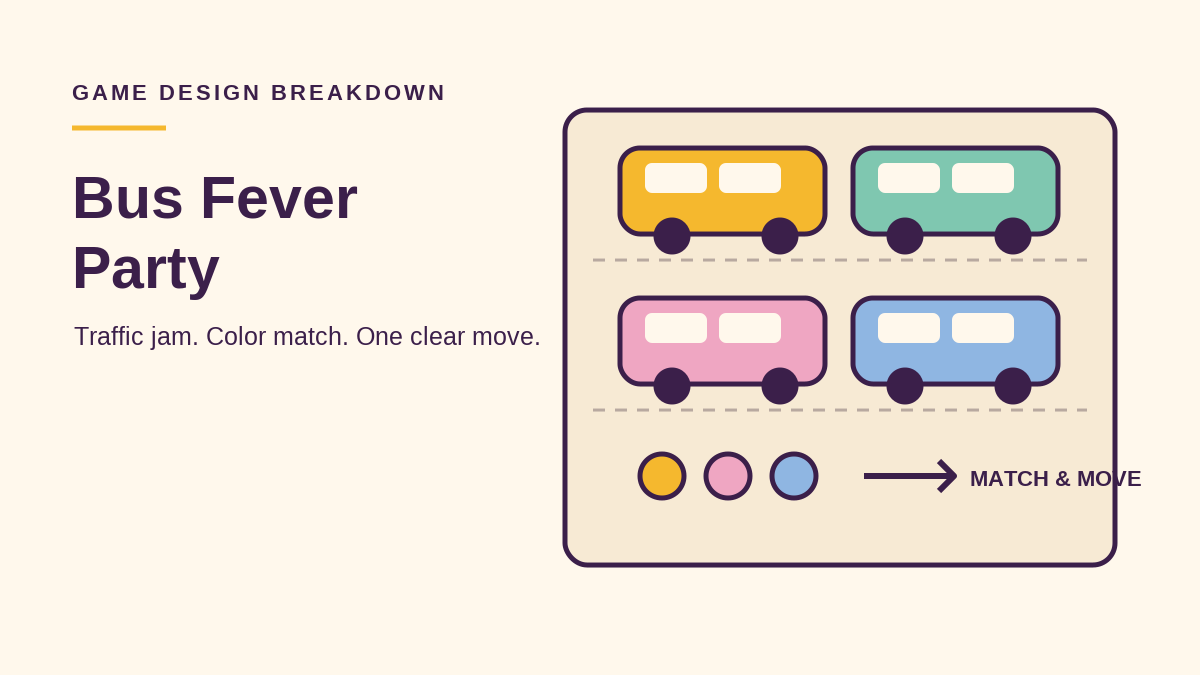
Bus Fever Party! turns a familiar traffic jam into a compact sorting puzzle: move buses out of a crowded lot, match waiting passengers to bus colors, and clear the board without trapping yourself. The public US App Store snapshot places it at #5 in Games and #4 in Casual and Puzzle (US App Store, as of 17 Nov 2026). That is a useful signal of visibility, not proof of why players downloaded it or how much it earns. We read its appeal as a combination of instantly legible goals, spatial planning, and a store page that promises both quick access and rising challenge.
At a glance
- Developer: Lumi Games, as listed in the US App Store listing.
- Chart position: #5 Games; #4 Casual; #4 Puzzle (US App Store, as of 17 Nov 2026), from our dated public chart snapshot.
- Release and store signals: snapshot records a 13 Jun 2025 release, free price, 29,278 ratings, and a 4.67469 rating value (snapshot metadata). These are listing signals, not a measure of active players or revenue.
- Monetization evidence: Apple labels the app as containing ads and in-app purchases. The listing names boosters and coin packs; it does not establish exact ad frequency, purchase conversion, or whether any pass is active.

What is the core loop?
The App Store listing describes three linked actions: tap buses to move them and open space, match passengers with buses by color, and park efficiently while avoiding obstacles. The satisfying unit is not simply “move a vehicle.” It is a small dependency puzzle. A bus that can leave may expose another route; a bus moved too early can occupy a scarce lane or leave the wrong color unavailable when passengers arrive. The player scans, predicts, commits, and checks whether that move freed the board.
That loop combines spatial untangling with color sorting. Each layer supports the other: the traffic arrangement governs which buses can move, while passenger demand determines which movement is valuable. This creates a useful tension between a legal move and a good move. The game’s store copy says “easy to play, tough to master”; our reading is that low-friction tapping lowers the entry barrier while constrained parking and color order can make planning the real skill. (This quoted phrase is under 25 words and attributed to the listing.)

Difficulty and pacing
A jam puzzle can scale in several readable ways: add vehicles, reduce open lanes, introduce more passenger colors, or force a particular order. Those are design levers, not claims about the exact level sequence in this game. The listing promises “hundreds” of puzzles and describes challenging traffic jams, but does not publish a level-by-level curve. We therefore avoid claiming a specific level count beyond the developer’s store wording, or that difficulty rises at a particular stage.
Good pacing gives players time to learn one constraint before combining it with another. Early boards can teach the move rules and establish the consequence of consuming a parking space. Later combinations can ask players to preserve a route while satisfying color demand. A hint or booster then feels like assistance with a visible knot, rather than a tax for not guessing. That distinction matters because the player should be able to explain, after failure, which decision created the dead end.
Meta, boosts, and the value proposition
The listing says the game has offline play, hundreds of puzzles, and boosters. It also promotes a limited “Maple Bus Escape Challenge” in its current listing copy. This supports a modest meta picture: the main progression is puzzle completion, with boosters as optional help and at least one time-bounded challenge as a reason to revisit. Store copy can change, so an event mention should be checked again before being treated as a permanent system.
We cannot verify a persistent collection, town-building layer, daily streak economy, battle pass, or a specific progression map from the snapshot and opened listing. The right analysis is to describe what is evidenced and leave the rest open. For a small studio, that restraint also keeps the product pitch coherent: one strong board-level loop can sustain a game without layering a sprawling meta on top.

Monetization: what can we responsibly infer?
Apple’s listing marks the app as free with in-app purchases and advertising. It names boosters and coin packs among purchase options; the game description says boosters help clear traffic jams. These facts make a hybrid model plausible: ads may monetize some sessions, while consumables can offer a shortcut or recovery path. The public information does not tell us when ads appear, what they reward, how much purchases cost in the US storefront, or whether a paid ad-removal option exists. We should not infer those details from individual reviews or from the mere presence of the “contains ads” label.
This distinction matters for design. A rewarded ad can be a player-chosen exchange when its value is clear and the level remains understandable without it. An interruption at a high-friction moment can feel different, especially when extra space or a booster seems required to make progress. The store page does not let us determine where this game lands. Our recommendation to any studio is to make the base puzzle fair, show exactly what an assist changes, and test whether usage reflects choice rather than confusion.
We also cannot verify a season pass or subscription. If a team were considering one, it should first demonstrate that free progression has a complete rhythm and that the paid track adds optional goals rather than essential board capacity. Our small-team LiveOps guide discusses event scope and pass design. For a contrast in puzzle fundamentals, see our puzzle game design guide and our Juice Fruit game page.
Why might it chart?
One snapshot cannot explain chart movement. It shows placement on a date, not installs, ad spend, retention, revenue, or the contribution of featuring. Still, we can identify product characteristics that plausibly help discovery and first-session comprehension. “Move buses, match colors, clear a jam” is easy to demonstrate in a short video or screenshot. The board state creates a visible before-and-after; each move offers an understandable question; and the theme is broadly recognizable without a long tutorial. Those qualities can support a clean store pitch and a satisfying moment-to-moment loop.
There is also a useful mix of immediate and delayed reward. Moving one vehicle can open a path now, while careful sequencing makes the full board solvable. Players can see a local action and anticipate a larger resolution. That structure often makes a puzzle legible to viewers: an obvious obstruction, a candidate move, then a satisfying clearance. We read the chart position as evidence of current visibility, not evidence that any one of these hypotheses caused it.
The store snapshot reports 29,278 ratings and 4.67469 rating value as of its capture. That is a substantial feedback surface, but ratings are neither a representative sample of all players nor proof of satisfaction across the whole difficulty curve. A careful studio reads reviews as diagnostic signals, checks recurring friction against telemetry, and avoids turning anecdotes into a universal verdict.
Four lessons for a small studio
- Make the first objective visual. A player should understand the board, target, and legal action before reading a paragraph. Test the first screen at thumbnail size and in motion.
- Scale constraints one at a time. Add a tighter lane, another color, or a new blocker only after players can explain the current rule. Track abandonment and retry rate by level to find abrupt walls.
- Keep assists legible. Explain whether a booster moves a bus, clears an obstacle, or creates space. Show the changed state before asking for a choice. Measure completion after assist use alongside no-assist completion.
- Separate puzzle fairness from monetization. Test whether a level is solvable with the resources normally provided. Ads and purchases should offer an explicit alternative, not conceal the intended solution.
- Use events to reframe the core loop. A short themed challenge can reuse board rules and art while giving returning players a fresh goal. Measure participation and completion; do not assume an event caused retention lift without a comparison.

What we would measure next
If we were evaluating a similar puzzle, we would instrument first-session completion, moves per level, undo or restart use, booster exposure, ad offer impressions and completions, and level-specific exits. We would segment by acquisition source and device where sample size permits. A chart rank may move while a game’s retention stays flat; a good monetization result can coexist with a poor frustration signal. Reading the measures together helps a small team decide whether to tune level design, clarify the offer, or improve store creative.
Sources and scope
All chart and snapshot metadata below refer to the frozen public capture. Store descriptions and event text can change after capture. Screenshots belong to the developer and are hot-linked from the official listing.
- Apple App Store: Bus Fever Party! — gameplay description, developer, listing signals, screenshots, and purchase disclosures.
- NabiGame public US chart snapshot, 17 Nov 2026 — chart ranks and app metadata.
- NabiGame: LiveOps for Casual and Puzzle Games — related internal article.
- NabiGame: Puzzle Game Design — related internal article.
As of 17 Nov 2026. Rank claims refer to US App Store, as of 17 Nov 2026. This article is independent analysis; NabiGame Studio is not affiliated with Lumi Games.
Comments
Loading comments…