
Block Blast is a clean example of a puzzle built around one repeatable decision: where can this shape go without closing off the board? In the public snapshot dated 17 November 2026, it sits at #9 in US App Store Games and #6 in both Casual and Puzzle. Those are chart positions, not download or revenue estimates. We read the placement as evidence of durable visibility for an immediately legible loop, not proof of any single cause.
This is a design reading by NabiGame Studio, not an inside account of Hungry Studio’s decisions. We use the App Store listing and Hungry Studio’s official site for game facts, then label our interpretation as inference. For more on the fundamentals behind clear goals and readable feedback, see our puzzle game design guide.
At a glance
- Game: Block Blast!, developed by Hungry Studio; the snapshot lists its iOS release date as 3 April 2022.
- Chart: #9 Games, #6 Casual, #6 Puzzle — US App Store, as of 17 Nov 2026.
- Store signals: free download, in-app purchases, advertising, 4.87 average rating across 2,858,164 ratings in the snapshot.
- Our read: very low rule-learning cost, high replayability, and a natural bridge between endless score chasing and authored objectives.

Why does the core loop work?
The App Store listing describes an 8×8 board and an endless high-score pursuit. Hungry Studio’s official overview calls out classic-style and adventure-driven play. In the familiar placement loop, players fit offered shapes onto the board, complete rows or columns to clear cells, then use that space to keep placing pieces. The exact rules and mode details can vary by version, so we keep this description at the level the publisher’s current materials support.
The appealing tension comes from making progress and protecting future choices at once. A line clear feels immediately rewarding; placing a large awkward shape may be necessary even when it does not clear anything. The board is both the puzzle and the visible consequence of earlier choices. Our original loop sketch summarizes this relationship:
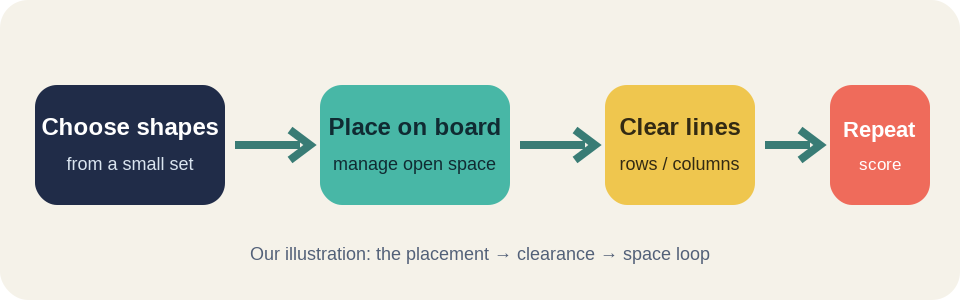

This simplicity lowers the first-session explanation burden. Players can understand the object of a move by looking at the board, and the satisfying clear provides a compact payoff. We read the visual feedback and short decision cycle as a strong fit for brief sessions, while the survival-style high-score goal gives experienced players a reason to keep refining their choices. That is a design hypothesis, not a measured retention result.
How does difficulty and pacing build?
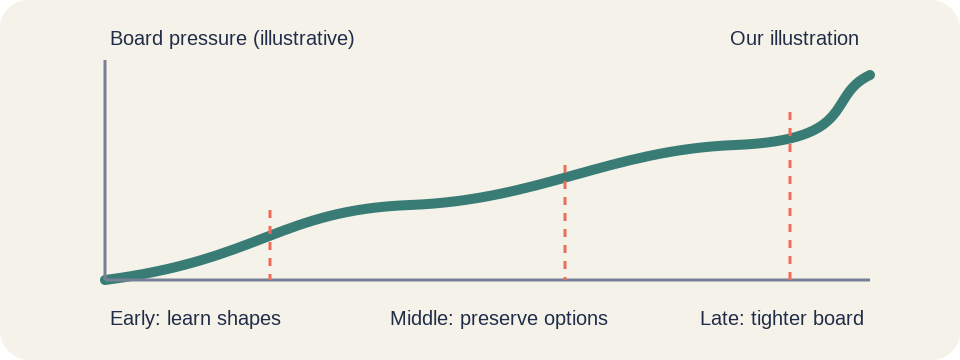
In an endless board puzzle, pressure can rise without a countdown. Each placement changes the remaining geometry; an awkward piece can make several future placements harder. A row clear releases space, so skillful play can temporarily reverse that pressure. This creates a readable rhythm of setup, release, and renewed constraint.
We interpret that as an elegant difficulty curve because it emerges from accumulated board state rather than a stream of new rules. A player can see why options are shrinking. That legibility matters: failure may feel like the result of a chain of decisions, rather than a surprise timer or hidden opponent. The curve below is our conceptual model, not telemetry or a claim about internally tuned difficulty.
The trade-off is that open-ended score pursuit can eventually feel repetitive or punishing. The official App Store listing also describes daily puzzle variety, while Hungry Studio describes Classic and Adventure modes. Read generously, those formats can serve different appetites: repeatable score mastery and more directed puzzle goals. We cannot infer exact cadence or level structure from those labels alone.

What does the meta add?
Block Blast appears to keep the board itself as the main event. Daily puzzles and Adventure give the listing a way to frame goals beyond a single endless score, without requiring a different control vocabulary. That is a useful product pattern: vary the objective and context while preserving familiar actions. It lets returning players spend attention on the puzzle rather than relearning input.
We would be careful not to overstate the meta. Public materials establish that the game offers different puzzle experiences; they do not document every progression system, reward schedule, or live event. For a small studio, the lesson is not to copy an assumed content calendar. First ask whether a new goal adds a distinct reason to play, and whether the existing mechanic can carry it.

How might monetization fit?
The snapshot marks the iOS app as free, with a zero price, and the App Store listing labels it as containing advertising and in-app purchases. The listing exposes subscription purchase options. We can verify those storefront signals, but not each ad placement, offer’s availability, or its contribution to revenue from this snapshot. Hungry Studio also announced an Apple Arcade edition in September 2026; its official announcement says that edition has no ads or in-app purchases. That is a separate product edition, not a description of the free mobile app.
Our interpretation is that a low-friction core can support optional monetization around continued play, convenience, or an ad-free experience, provided the basic puzzle remains understandable and playable. But the public sources here do not establish exactly how the mobile version gates retries or presents rewarded ads, so we will not claim that it does. A responsible studio should test the interruption cost and explain paid benefits clearly.
Why might it chart?
The snapshot gives a narrow but useful answer: on one date, the game held strong positions in three US App Store categories, alongside a high rating and a large rating count. Those are observable storefront signals. We cannot identify their causes from a chart snapshot, and category rank does not equal unit sales.
Our hypothesis is a combination of accessible rules, a repeatable high-score challenge, clear moment-to-moment feedback, and a way to offer more directed puzzle goals. The official listing’s rating and rating count are consistent with a broad base of people willing to rate the app; they do not tell us why each person plays. We would also expect marketing, distribution, updates, and audience fit to matter, but this data cannot isolate their effects.
Four takeaways for a small studio
- Make the board explain the move. Use visual affordances to show where a piece fits and what a clear will affect. Reduce tutorial text when the playfield can teach safely.
- Build pressure from player state. A spatial constraint can create pacing without a timer. Make the source of pressure visible and give skilled play a way to recover space.
- Vary goals before controls. A daily challenge or authored objective can refresh a stable mechanic. Prototype one variant and check whether players understand its goal before producing a large content pipeline.
- Keep monetization legible. Treat ads and purchases as part of the session rhythm. Measure interruptions, return behavior, and satisfaction alongside revenue; do not assume a chart position validates a particular offer.
For our own work, the useful comparison is not “make another block game.” It is to look for a mechanic whose state is easy to read and whose risk accumulates through understandable choices. That principle also informs our Fruit Merge: Juicy Puzzle, where placing pieces and managing board space shape the next decision.
Sources and scope
- Apple App Store: Block Blast listing — product description, category, monetization labels, and screenshots.
- Block Blast official site — publisher overview, game modes, and FAQs.
- Hungry Studio: Block Blast!+ joins Apple Arcade — separate ad-free edition announcement.
- Hungry Studio: About Block Blast and studio — publisher background.
- NabiGame public US App Store snapshot, 17 Nov 2026 — chart positions and listing metadata.
As of 17 Nov 2026. Rank claims refer to US App Store, as of 17 Nov 2026. Store details can change; chart positions are a point-in-time snapshot. Our design explanations are analysis, not claims about Hungry Studio’s internal methods.
Comments
Loading comments…