
We make Roiva: ROI & Business Metrics at NabiGame; this guide explains it and the topic, it is not an independent review. ROI measures gain relative to cost, NPV values future cash flows today, and IRR finds the rate at which those flows break even in present-value terms. Roiva helps you explore these estimates alongside payback, margins, and break-even volume; the result depends on your assumptions.
Key takeaways
- Match the metric to the question: investment return, cash recovery, pricing, and operating profitability need different calculations.
- Timing matters: compare consistent periods, cash flows, currencies, and discount rates.
- Check the downside: an attractive result is a scenario, not a promise or investment recommendation.
- Know the limits: Roiva works offline without an account, but includes an ads and analytics SDK.
Who is this Roiva calculator guide for?
This guide suits small-business owners, freelancers, and independent makers comparing equipment purchases, service pricing, or a new product idea. Our recommendation at NabiGame is to start with a clearly written decision: “Can this purchase recover its cost?” is more useful than “Is this a good business?” The first question has inputs you can inspect; the second needs context a calculator cannot supply.
Use Roiva for a focused calculation and saved scenarios. Use a spreadsheet when you need custom schedules, linked budgets, or irregular dates; Microsoft documents dated cash-flow functions in its NPV and IRR guide, checked November 2026. Bring accounting treatment and consequential financing decisions to an appropriately qualified adviser.
Real examples
All people and figures below are hypothetical, prepared in 2026 for teaching. The arithmetic matches Roiva's formulas in the reviewed source; discount rates are typed as decimals (0.10 means 10%).
1. A small roaster weighs a new roasting machine
Situation: a coffee roaster can buy equipment for 250,000 USD. She expects 80,000, 110,000 and 140,000 USD of net cash in years 1 to 3 and requires a 10% return.
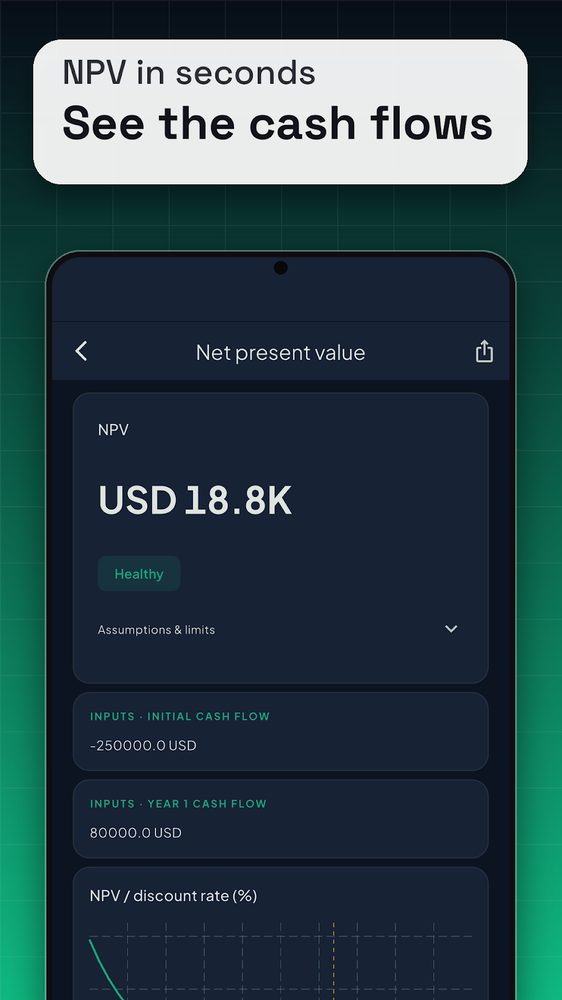
- Open Net present value (the screen in the second screenshot). Enter Initial cash flow
-250000, Year 180000, Year 2110000, Year 3140000, Discount rate0.10. - The result is USD 18,820.44, shown as 18.8K with a Healthy badge, as in that screenshot. Undiscounted, she gets back 330,000 USD for 250,000 USD; discounted at 10%, she is still ahead by about 18.8K.
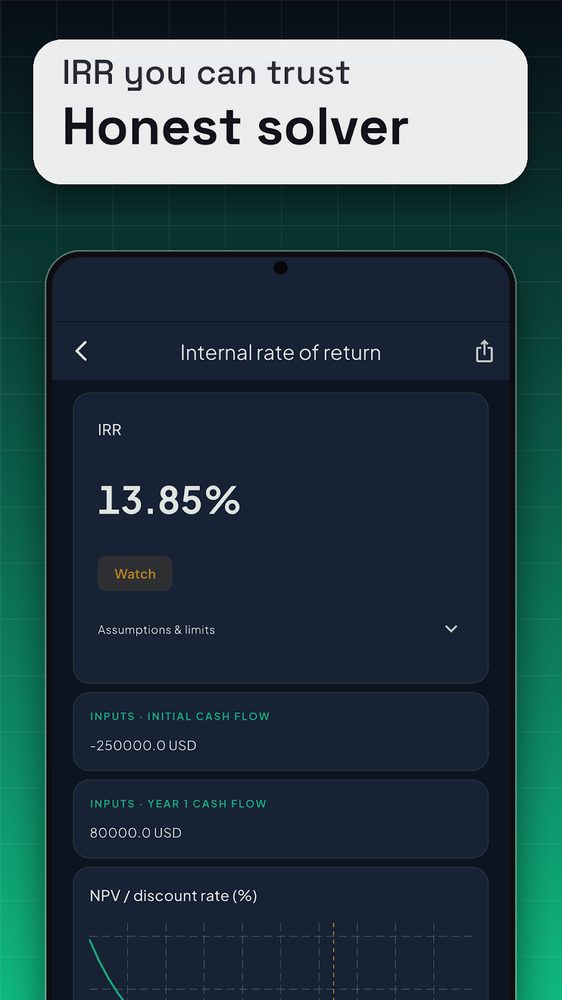
- Open Internal rate of return with the same four cash flows (third screenshot): 13.85%. The badge says Watch for every IRR, because the app does not invent a benchmark rate for you.
- Open Payback period: after year 2 she is 60,000 USD short, and year 3 brings 140,000, so payback is 2 + 60,000/140,000 = 2.43 periods.
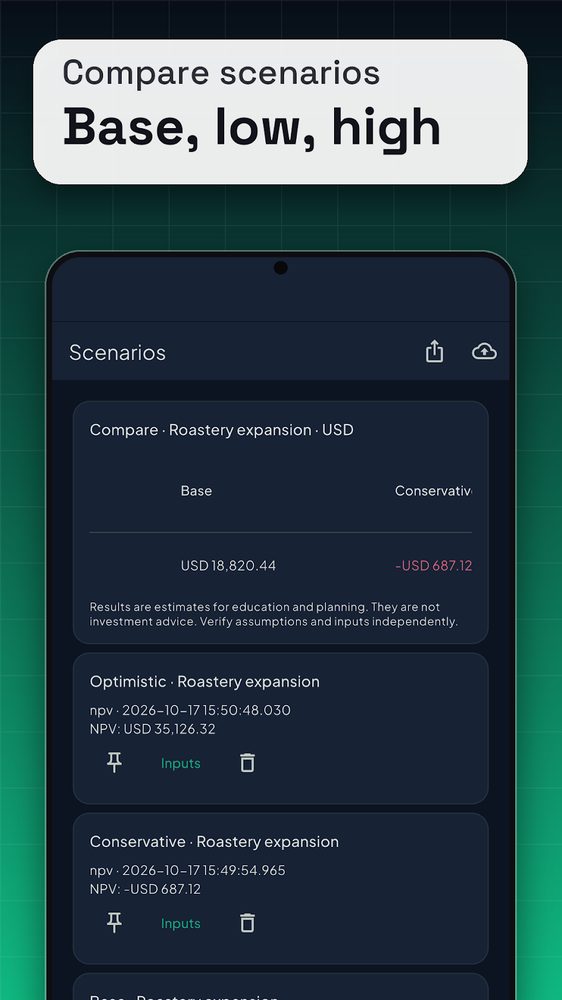
- Save it as Base, then rerun NPV with Discount rate
0.14and save as Conservative. NPV drops to -USD 687.12. That matches the comparison card in the fourth screenshot: Base 18,820.44 against Conservative -687.12.
Outcome: the machine clears a 10% hurdle but not a 14% one, because the IRR of 13.85% sits just below 14%. Whether 14% is the right bar is her judgement; the app only shows where the answer flips.
2. A freelance designer decides on a 3,600 USD workstation
Situation: a freelancer expects a faster computer to bring 1,500 USD of extra net income each year for three years.
- Open Simple ROI. In Gain enter the total returned,
4500(3 x 1,500), and in Cost enter3600. ROI = (4,500 - 3,600) / 3,600 = 25%. Typing the net profit of 900 into Gain would subtract the cost twice and give a wrong answer. - Open Net present value: Initial
-3600, Years 1 to 31500each, Discount rate0.10. NPV is about USD 130.28. - Open Payback period with the same flows: after two years she is 600 USD short, so 2 + 600/1,500 = 2.4 periods.
- Use the sensitivity control on the result screen: pick Year 1 cash flow and drag it negative to see how the result moves if the extra work does not arrive.
Outcome: a 25% ROI sounds comfortable, but the discounted margin is only about 130 USD. A thin NPV tells her the purchase depends on the income actually arriving.
3. A market-stall baker checks monthly volume
Situation: a baker pays 1,800 USD per month of fixed costs (stall rent, licence, equipment). A loaf sells for 4.50 USD and costs 1.90 USD in ingredients and packaging.
- Open Break-even & target volume. Enter Fixed costs
1800, Unit price4.5, Unit variable cost1.9, Target profit1000. - Each loaf contributes 2.60 USD, so 1,800 / 2.60 = 692.3, shown rounded up as 693 loaves. For the 1,000 USD target, (1,800 + 1,000) / 2.60 = 1,076.9, so 1,077 loaves.
- Open Gross profit & margin with Revenue
4.5and COGS1.9: gross margin is 57.78%. - Open Markup, margin & target price with Unit cost
1.9and Target margin0.60(a decimal): target price is 1.90 / 0.40 = 4.75 USD.
Outcome: 693 loaves a month is about 23 a day over 30 days, which she can judge against her real sales. The same calculator also shows what raising the price to 4.75 would do to the volume needed.
How do ROI, NPV, and IRR differ?
ROI: how much did the investment gain?
BDC defines ROI in its business guide, checked November 2026:
“Return on investment (ROI) is a financial ratio that measures the profit generated from investments.”
— BDC, Return on investment
Simple ROI = (total returned − initial cost) / initial cost × 100%. Keep the numerator explicit. In Roiva's Simple ROI calculator, the field named Gain means the total returned before subtracting the separate Cost field; entering net profit there would subtract the initial cost again.
Hypothetical example prepared in 2026: spend $10,000 now and receive $12,000 after all other relevant costs over the modeled investment. Net gain is $2,000, so ROI is 20%. These are teaching assumptions, not NabiGame results or market benchmarks; the calculation follows BDC's gain-to-investment approach. State the investment's duration: the same total ROI over a longer wait is not the same annual performance.
NPV: what are future cash flows worth today?
NPV = initial cash flow + sum of each future cash flow / (1 + discount rate)^period. Record the initial purchase as negative and subsequent net receipts as positive. Microsoft's NPV documentation, checked November 2026, makes clear that periodic future flows occur at period ends; an immediate initial outlay is handled separately in Excel.
Hypothetical 2026 planning example: pay $10,000 immediately, then receive $4,000 at each annual period end for three years. At an assumed annual discount rate of 10%, NPV = −10,000 + 4,000/1.10 + 4,000/1.10² + 4,000/1.10³ = −$52.59, rounded. This is our worked application of the NPV formula, not a recommended discount rate.
The undiscounted receipts exceed the purchase price, yet the discounted result is slightly negative. Under these assumptions, the investment falls short of the chosen return requirement. That illustrates why a positive simple ROI cannot answer the timing question on its own.
IRR: which discount rate makes NPV zero?
IRR solves the NPV equation for the rate instead of asking you to supply it. For the same hypothetical example prepared in 2026, the annual IRR is approximately 9.70%, calculated using the Microsoft-described relationship between IRR and NPV. It is a modeled break-even discount rate, not interest a bank promises to pay.
Microsoft's guidance, checked November 2026, also warns:
“However, sometimes there can be more than one acceptable IRR, or sometimes none at all.”
— Microsoft, Microsoft Support
Later cleanup, replacement, or closure costs can turn positive cash flows negative again. Roiva's reviewed source searches a bounded range and reports multiple roots it finds; that is not proof every possible root was found. Our rule of thumb: if IRR becomes ambiguous, inspect the cash-flow sequence and compare NPV at a justified rate instead of selecting the most flattering percentage.
How should you choose the discount rate?
Write down what return requirement the rate represents and why it fits the project. Do not choose a rate solely to make NPV positive. ACCA's investment-appraisal guidance, checked November 2026, explains that inflation must be treated consistently in cash flows and discount rates: nominal with nominal, or real with real.
The cash-flow forecast deserves equal attention. ACCA highlights working capital:
“The key issue that must be remembered here is that an increase in working capital is a cash outflow.”
— ACCA, Investment appraisal
Our recommendation is to list inventory needs, payment delays, maintenance, and eventual disposal beside the purchase price. Recalculate with weaker receipts and a more demanding discount rate. If that changes the decision, investigate those assumptions before treating the headline result as useful evidence.
What do payback, margin, and break-even tell you?
Payback measures recovery time
Payback tracks when cumulative net cash receipts recover the initial outlay. With equal inflows, simple payback = initial investment / periodic net inflow. For our hypothetical 2026 example, $10,000 / $4,000 = 2.5 years, using Roiva's within-period interpolation convention, described in its payback tool and verified source.
That fractional estimate assumes receipts arrive evenly within the recovery period. If they arrive only at year-end, recovery occurs at the final receipt instead. Simple payback leaves out discounting and what happens after recovery; discounted payback applies the selected rate before accumulating receipts. Neither should replace the full cash-flow view.
Margin measures profit relative to sales
BDC describes gross profit margin in its financial-indicators guide, checked November 2026:
“Your gross profit as a portion of your sales.”
— BDC, Financial indicators
Gross margin = (revenue − cost of goods sold) / revenue × 100%. Net margin instead uses net income after the relevant expenses. For a hypothetical 2026 sale of $50 with $30 cost of goods sold, gross profit is $20 and gross margin is 40%, applying BDC's formula. This does not mean the business keeps that entire amount after overhead and taxes.
Break-even estimates required sales volume
The SBA's break-even guide, updated October 2024, states:
“This break-even analysis is based on the foundation of a single product or service.”
— U.S. Small Business Administration, Break-even point
Break-even units = fixed costs / (unit price − unit variable cost). In a separate hypothetical monthly scenario prepared in 2026, fixed costs are $2,000, unit price is $50, and variable cost is $30. Applying the SBA formula gives $2,000 / $20 = 100 units per month. Round fractional units upward; Roiva does this automatically.
Keep the cost period consistent and contribution positive. A business selling a changing mix of products needs more than a single average price assumption. Our recommendation: test whether the required sales volume is plausible before using break-even as a reason to expand.
What Roiva does and does not do
The Google Play listing and source reviewed in November 2026 confirm ROI, NPV, IRR, payback, discounted payback, margin, and break-even calculators. You can save scenarios, compare cases, and export CSV or PDF reports. The reviewed periodic investment screens use an initial cash flow and three annual cash-flow fields; this is not an unlimited dated project model.
Roiva has no live market feed or currency conversion. Changing currency changes display formatting, not the economic value of an input. Outputs are estimates for education and planning, not investment, tax or accounting advice. It cannot validate your demand forecast, choose an appropriate risk assumption, or replace bookkeeping. Browse our apps and community tools for its broader context.
Does offline mean no data activity?
Calculations work offline without an account, and saved scenarios use local storage. The reviewed app includes AdMob, Firebase Analytics, and consent handling through NabiAppSDK; its privacy screen describes calculator identifiers and event metadata. Therefore, offline calculation should not be read as a blanket no-collection promise. Exporting a report also means choosing where to share or save that file.
How Roiva differs from other apps
We make Roiva, so treat this as a description of what we built, not a ranking. Each point below can be checked in the app or its store listing.
- No account, no signup. Some web-based finance tools ask you to register to save work. Roiva opens straight to the calculators and keeps saved scenarios in local storage on the phone.
- 37 calculators in one app, in five groups: Business, Investment, Marketing, AdMob and Real estate. That includes NPV, IRR, payback, discounted payback, profitability index, WACC, DCF, CAC, LTV/CAC, cap rate and DSCR, so you do not need a separate app per formula.
- IRR reports every root it finds. Roiva scans a bounded rate range and lists each sign-change root, labelled as multiple roots when the cash flows are non-conventional. It is a bounded search, not a proof that no other root exists.
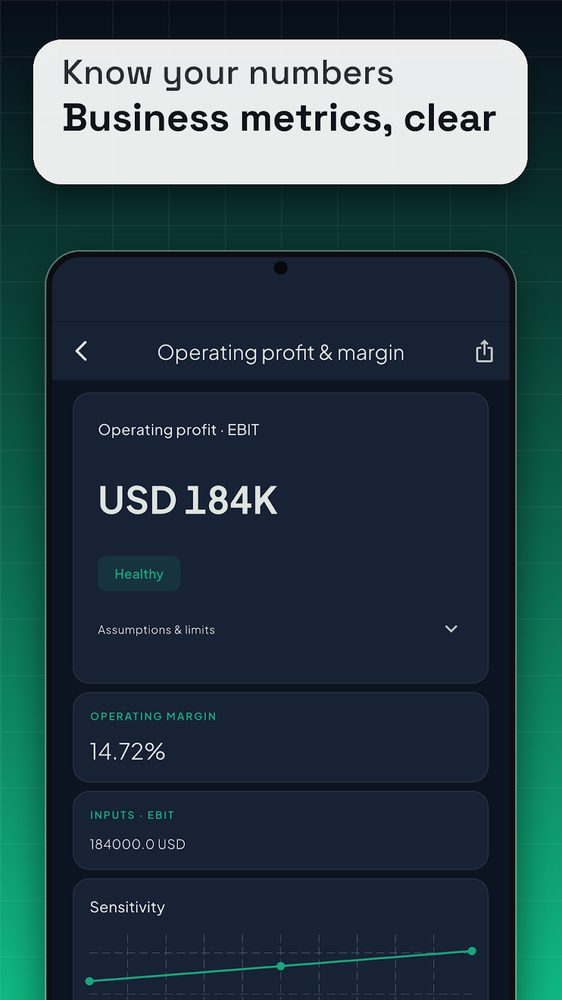
- Assumptions on every result. Each result card has an “Assumptions & limits” panel, the inputs you entered, and a sensitivity control that changes one input by a percentage so you can see the effect.
- Base, Conservative and Optimistic cases. Saving asks for a case label, and the Scenarios screen compares saved cases and lets you pin one. Reports export as CSV or PDF.
- Small permission footprint. The app's own Android manifest declares only Internet, network state and vibration; ad and analytics libraries may add their own entries at build time, so check the Play listing for the final list.
When to pick something else
- Irregular dates or many cash flows: Roiva's NPV and IRR screens take an initial flow plus three annual flows. Use a spreadsheet with XNPV/XIRR for dated or longer schedules.
- Full company models, linked budgets or multi-user collaboration: use accounting or spreadsheet software.
- No ads wanted: the app includes AdMob banners and Firebase Analytics with a consent flow. If you want a tool with no ad or analytics SDK at all, choose one that says so.
- Currency work: there is no exchange-rate feed; the currency setting only changes display.
How to get started in three steps
- Pick a question. Open the relevant calculator and read its formula. Gather cost, cash-flow, or sales assumptions in a consistent currency and period.
- Enter and inspect. Check signs, field units, and the assumptions shown with the result. For ROI, distinguish total returned from net gain; for NPV, distinguish the immediate outlay from later receipts.
- Save and compare. Name the base case, then save a conservative case with a clearly changed assumption. Export a report if you need to discuss the inputs with an adviser.
Our preference is a modest forecast you can explain over an impressive figure you cannot defend. For a related interactive product idea, see our studio services, or contact NabiGame with the calculation workflow you want to discuss.
FAQ
Is ROI the same as profit margin?
No. ROI compares gain with investment cost; margin compares profit with revenue. State the denominator before comparing results.
Can positive ROI coexist with negative NPV?
Yes, as the worked example shows. Simple ROI ignores timing, while NPV discounts receipts using a chosen return requirement.
Does the highest IRR always identify the best project?
No. Review cash amounts, timing, and the assumptions behind the comparison. Multiple roots can also make the headline rate ambiguous.
Can Roiva convert currencies or supply market forecasts?
No. Currency selection changes formatting, and you supply the assumptions. Its results are estimates rather than live market information.
Can I use Roiva without signing in?
Yes, the listing and reviewed source confirm no account is needed. Offline calculations and local scenarios coexist with the app's ads and analytics integration.
Sources
- Roiva on Google Play — listing checked November 2026; feature claims also checked against app source.
- BDC: Return on investment — checked November 2026.
- Microsoft: NPV function — checked November 2026.
- Microsoft: Calculate NPV and IRR — checked November 2026.
- ACCA: Investment appraisal — checked November 2026.
- BDC: Financial indicators — checked November 2026.
- SBA: Break-even point — updated October 2024; checked November 2026.



Comments
Loading comments…