
We make Repzo: Interval Timer at NabiGame; this guide explains it and the topic, it is not an independent review. An interval timer repeats work and recovery periods so you can follow a routine without resetting a countdown. Repzo supports HIIT, Tabata, EMOM and boxing templates, but choosing the timing does not choose the right exercise or intensity for you.
Key takeaways
- Timing and effort are different: a preset controls the clock, not your technique or exertion.
- Tabata is a specific historical protocol: borrowing its timing does not reproduce the original research.
- EMOM includes recovery inside the minute: finishing your assigned work does not mean filling every remaining second.
- Repzo is a timer: it offers presets, custom routines and local history, not personalized coaching.
Real examples
Dana, a 4-minute Tabata block on a lunch break
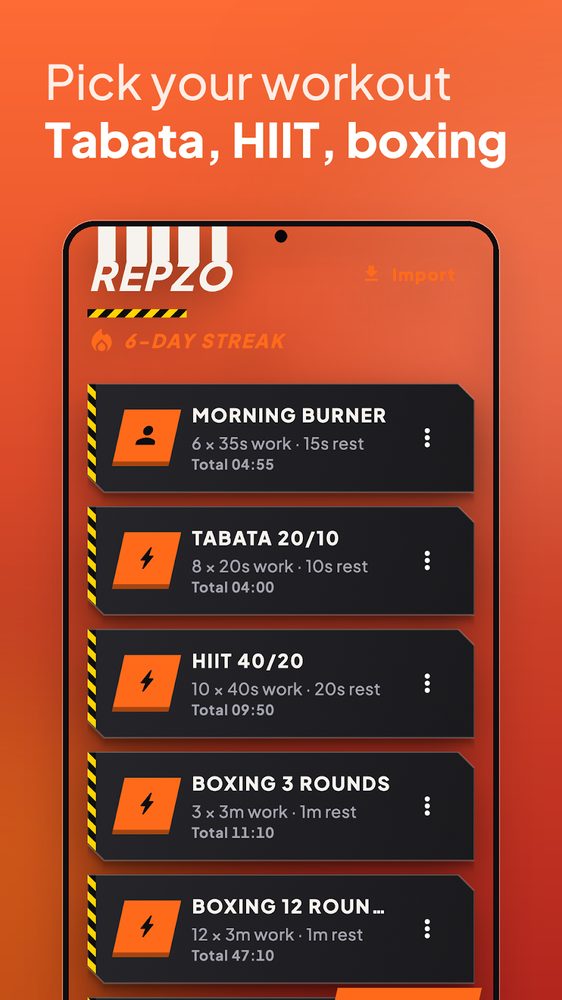
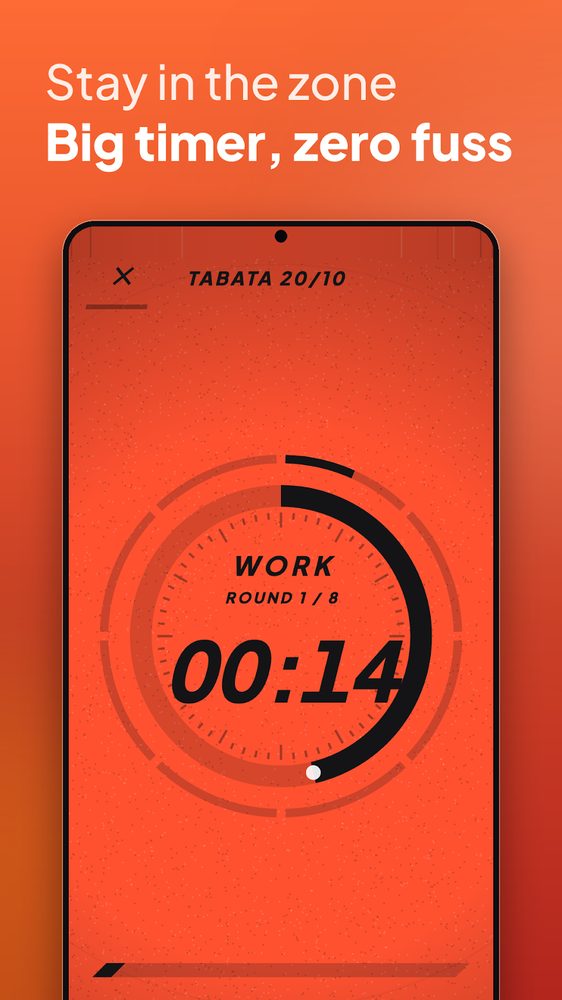
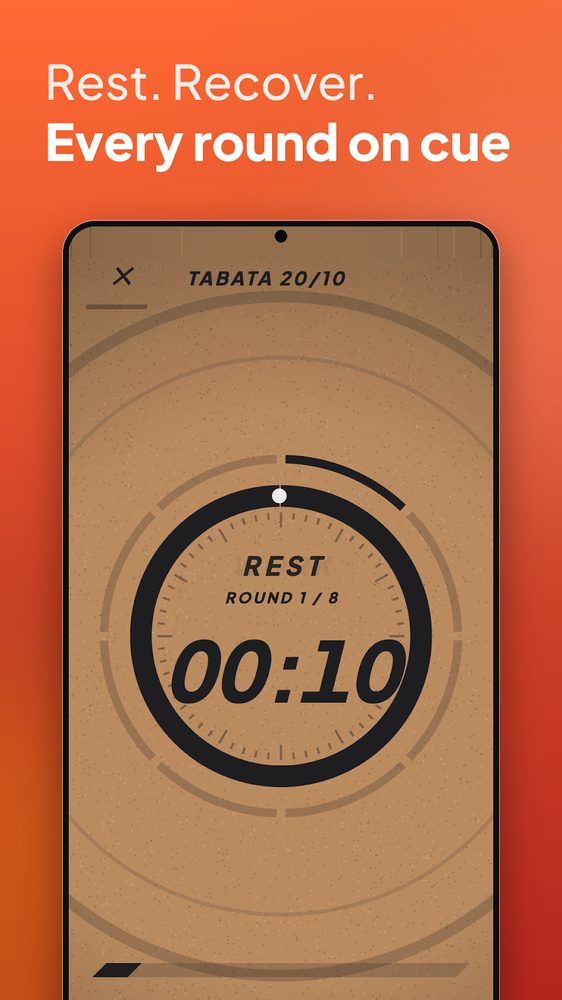
Dana has a plan from her trainer: eight rounds of 20 seconds work and 10 seconds rest, one exercise. She opens Repzo and taps Tabata 20/10 in the list (first screenshot). The card shows "8 × 20s work · 10s rest" and "Total 04:00". That total is checkable: 10 s get ready + 8 × 20 s work + 7 × 10 s rest = 240 s, because Repzo leaves out the rest after the last work interval. She taps Start. The dial turns orange for WORK, "Round 1 / 8" (second screenshot); when work ends it switches to the tan REST screen with 00:10 (third screenshot). She never touches the phone again until round 8 ends. Outcome: a four-minute block with no clock resets; how hard she works inside each 20 seconds is still her call.
Minh, a custom 4:55 "Morning Burner"
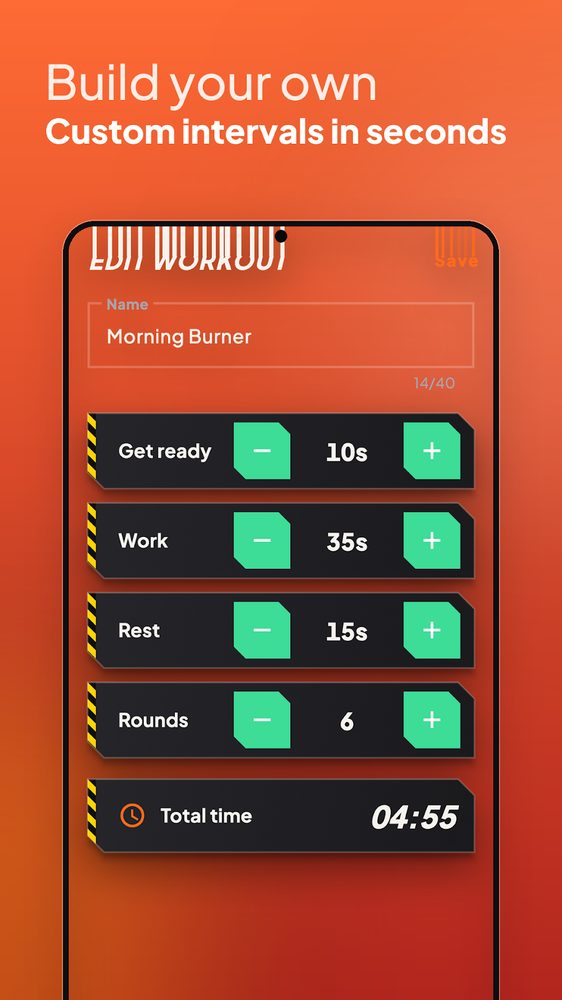
Minh's routine is 35 seconds on, 15 off, six rounds. No preset matches, so he opens the builder (fourth screenshot), names it "Morning Burner" (the name field allows 40 characters), and sets Get ready 10 s, Work 35 s, Rest 15 s, Rounds 6 with the plus and minus buttons. The Total time row updates as he goes: 10 + 6 × 35 + 5 × 15 = 295 s = 04:55. After Save, it sits at the top of the workout list as "6 × 35s work · 15s rest, Total 04:55" (first screenshot). Outcome: 3 minutes 30 seconds of scheduled work in under five minutes. He can copy its repzo: text code and paste it to a friend, who imports it with the Import button.
Linh, an EMOM 10 with kettlebell swings
Linh's plan: 10 swings at the start of every minute for ten minutes. She picks the built-in EMOM 10, which is 10 s get ready then ten 60-second windows with no rest phase, so 10 + 10 × 60 = 610 s = 10:10. At each new-round cue she does her 10 swings; if they take 35 seconds, the other 25 seconds are her recovery, because Repzo cannot see when she finishes. Outcome: she counts reps and the app counts minutes. If the swings start eating the whole minute, the CrossFit BC advice above applies: lower the reps or the load, not the clock.
How do interval timers and work/rest ratios work?
A repeating interval routine separates preparation, work, recovery and round count. Preparation gives you time to put the phone down. Work is the scheduled activity window; recovery is the gap before the next effort. The round count tells the timer when to stop repeating that pattern.
A work/rest ratio compares the length of those windows. Longer work relative to recovery means more scheduled activity within each cycle, but the ratio alone cannot describe difficulty. The movement, load, pace and your own fitness still matter. Our rule of thumb is to choose a routine you understand before choosing an impressive-looking preset.
The CDC's guidance, updated in 2025, explains relative intensity through the person doing the activity. A movement that feels vigorous to someone may feel moderate to someone fitter. Its talk-test description is a useful reminder that a timer display cannot measure effort:
“A person doing vigorous-intensity activity cannot say more than a few words without pausing for a breath.”
Use that distinction when reading HIIT labels. Hard efforts alternating with recovery describe a training format, not a promise that pressing Start delivers a particular fitness outcome. We recommend treating the timer as a prompt to follow an appropriate plan, not as permission to ignore how the session feels.
What is the difference between HIIT, Tabata, EMOM and boxing rounds?
HIIT: a category, not a universal setting
HIIT combines demanding efforts with recovery. A 2013 research paper in the Journal of Sports Science and Medicine describes recovery as either complete rest or low-intensity activity. That leaves considerable room for different movements and schedules; a preset name cannot tell you whether a routine suits your current ability.
For example, the Repzo listing checked in 2026 includes HIIT 40/20: the values describe work and rest in seconds. Treat it as an editable template rather than a beginner prescription. If your existing plan specifies a different balance, use the custom workout builder.
Tabata: where did the short work/rest pattern come from?
The 2013 paper traces Tabata training to Izumi Tabata's 1996 study. It describes eight bouts of 20-second all-out exercise separated by 10-second rests, commonly presented as a four-minute block. The historical protocol involved a specified exercise intensity; copying the clock pattern alone is not equivalent to repeating the experiment.
That distinction matters when a gentle circuit or a collection of unrelated exercises is called “Tabata.” You can use the timing without claiming the original study's outcomes. We would describe a modified routine as Tabata-style intervals, then explain the actual movements and intended effort.
Repzo's current implementation omits recovery after the final work interval. Its displayed total includes preparation, so check the preview instead of assuming that every app counts the opening and closing periods identically. Preparation is also not a substitute for warming up.
EMOM: work first, then use the remaining time to recover
The CrossFit BC glossary, accessed in 2026, defines the abbreviation plainly:
“EMOM means Every Minute On the Minute.”
— CrossFit BC, What Is an EMOM Workout?
You start the assigned work at the beginning of each minute, complete it, then recover until the next minute starts. CrossFit BC recommends scaling the repetitions or load when the work leaves insufficient recovery. The aim is not automatically to keep moving until the next beep.
Repzo implements its EMOM preset as consecutive minute-long work windows without a separate rest phase. The screen therefore cannot tell when you finish your repetitions. You decide when the assigned work is complete and rest within that window; the next round cue marks the next start.
Boxing rounds: a clock structure, not technique instruction
The ABC Unified Rules published by WBO-Europe, showing amendments through 2016, provide a familiar professional-boxing timing reference:
“Each round shall consist of a three (3) minute duration, with a one (1) minute rest period between rounds.”
— Association of Boxing Commissions, ABC Rules of boxing, WBO-Europe
That is a reference format, not a claim that every competition or training session uses identical rounds. For bag work or shadowboxing, follow your coach's plan and adjust the timer accordingly. Put the phone somewhere visible and beyond striking range. A round ending tells you that time elapsed; it does not assess your guard, balance or readiness for sparring.
Which protocol should you pick?
- Choose repeating work/rest intervals when your plan specifies how long to move and how long to recover. Match those instructions before changing the ratio.
- Choose Tabata-style timing when that brief work/recovery pattern is explicitly appropriate for your plan. Do not select it solely because it sounds efficient.
- Choose EMOM when your plan specifies a manageable task at each minute boundary. Leave recovery inside the window.
- Choose boxing rounds when you need longer blocks for a coach-directed drill, with clear recovery breaks between them.
Our recommendation is to change the schedule deliberately, rather than increasing work duration, rounds and exercise difficulty together. Keep enough context outside the timer to remember what you intended to practice. A saved duration is useful, but it is not a complete training plan.
What Repzo does and does not do
The Google Play listing, checked in 2026, confirms a large timer dial, phase colors, beeps, haptics, countdown cues, pause and skip controls, and a keep-screen-on option. It also lists custom workouts, shareable text codes, session history, streaks and short Learn explanations. You can find its studio entry at Repzo on our apps page.
Repzo suits people who already know their exercises and want repeatable timing with fewer manual resets. The custom builder sets a name, preparation, work, rest and rounds. It repeats that timing pattern; it is not an exercise-by-exercise program editor with independent durations for every movement.
Our listing's honest limit is direct: Repzo is a timer, not medical or training advice. Listen to your body and check with a professional before intense exercise. The in-app lessons likewise explain that Repzo cannot judge technique or intensity. History records timer sessions, not proof that every repetition was completed correctly.
Does offline use mean no data collection?
Works offline. No account needed. Those statements appear in the Play listing and match the local storage implementation for settings, workouts and history. Sharing copies a self-contained workout text code; it does not create a cloud account or synchronize your history.
Offline functionality is not the same as an absence of network services. The listing says the app contains ads, and the source integrates advertising and analytics through our shared SDK. During this review, the listing's data-safety labels and those integrations did not establish a consistent basis for a “no collection” promise. We therefore make no such promise here; review the current store disclosures before installing.
How do you get started in three steps?
- Choose your timing. Open Workouts and select a suitable preset, or create a custom routine. Check preparation, work, rest, rounds and total time against your intended plan.
- Test the cues. Review sound, haptics and keep-screen-on settings. Run a practice cycle in your actual listening setup before relying on cues during exercise.
- Start, then review. Follow the planned work and recovery, pausing when needed. Afterwards, use History to review the timer session, or copy a custom workout code for someone who uses Repzo.
Android background cues are implemented, but phone battery restrictions can interfere. Our source README still flags real-hardware audio verification as incomplete. Test locked-screen behavior on your phone; do not interpret the existence of a background service as a universal reliability guarantee.
How Repzo differs from other apps
We make Repzo, so read these as facts about our app that you can check, not as a ranking. Compare against whichever timer you use now.
- No account, no server for your workouts. Workouts, settings and history are stored on the phone. Sharing is a
repzo:text code (a base64 encoding of a small JSON) that you paste anywhere; it carries the routine, not your history or streak. - Works offline. The timer does not need a connection. The app does show ads and uses analytics through our shared SDK, as the privacy section above explains.
- The clock is calculated from elapsed time. The engine works out the current phase from how much time has passed, so a late tick or a locked screen does not make it lose seconds. On Android a foreground service plays beeps and vibration with the screen locked; we have not yet verified that by ear on real hardware, and battery restrictions on some phones can interfere.
- Roomy limits for a free timer. Up to 99 rounds, work up to 3600 s, rest up to 3600 s, get ready up to 600 s. The built-in list already includes a 12-round boxing session (47:10).
- Streaks allow one rest day, and abandoned sessions are saved with rounds done out of rounds planned instead of being discarded.
- Presets are editable starting points, not locked programs: Tabata 20/10, HIIT 40/20, Boxing 3 and 12 rounds, EMOM 10, plus duplicate, edit and delete for your own.
When to pick something else
Repzo repeats one work/rest pattern. If you need a different duration for every exercise in a circuit, exercise names on screen, wearable or watch support, cloud backup across phones, or video coaching, choose an app built for that. If your phone's clock already runs a single timer for you, you do not need to switch.
Repzo versus phone clocks and other interval apps
A phone clock can be enough for a single timed task. Google's Clock documentation, accessed in 2026, describes timer sounds, increasing volume and vibration settings, with this qualification:
“Not all devices have a timer vibrate option.”
— Google, Clock Help
Our preference for a dedicated interval timer begins when the task involves repeated phase changes and round tracking. Repzo explicitly models those phases. If your existing clock already handles your routine comfortably, switching is optional.
When comparing other interval apps, check the needs that matter to you: independent exercise labels, mixed-duration sequences, wearable support, backup, accessibility and cue behavior. Verify each candidate's current listing and settings. Repzo's documented feature set should not be read as a promise of those additional capabilities.
Which mistakes should you avoid?
Do not treat the preparation countdown as a warm-up, the EMOM work label as an instruction to eliminate recovery, or a saved streak as a reason to override your plan. Check whether the timer includes final recovery before comparing session totals. Test cues with the headphones or speaker you actually use.
From our perspective at NabiGame Studio, a useful timer makes the next action clear without pretending to be a coach. That is also a useful design principle for readers exploring our development services. If a timing label feels unclear, tell us what confused you.
FAQ
Is a Tabata timer the same as a HIIT timer?
Tabata-style timing is a particular pattern within the broader interval-training discussion. A configurable HIIT timer can run that pattern, but the selected exercise and intensity determine what the session actually involves.
Why does Repzo's EMOM preset show work without a rest phase?
Each window covers the whole minute, including your recovery after the assigned repetitions. Finish the work, then rest until the next round begins; Repzo does not detect completed repetitions.
Can I use Repzo without an account or internet connection?
The core timer and local workout storage work offline without an account. That does not mean the app has no advertising or analytics integrations, as explained in the privacy section.
Will Repzo back up my workout history to another phone?
The reviewed implementation stores history locally and does not provide account-based history synchronization. A shared workout code transfers the routine configuration, not your session history or streak.
Does completing a preset prove I trained at the intended intensity?
No. Repzo tracks the timer session; it cannot assess exercise technique or effort. Use an appropriate training plan and qualified guidance when deciding how intensely to exercise.


Comments
Loading comments…