
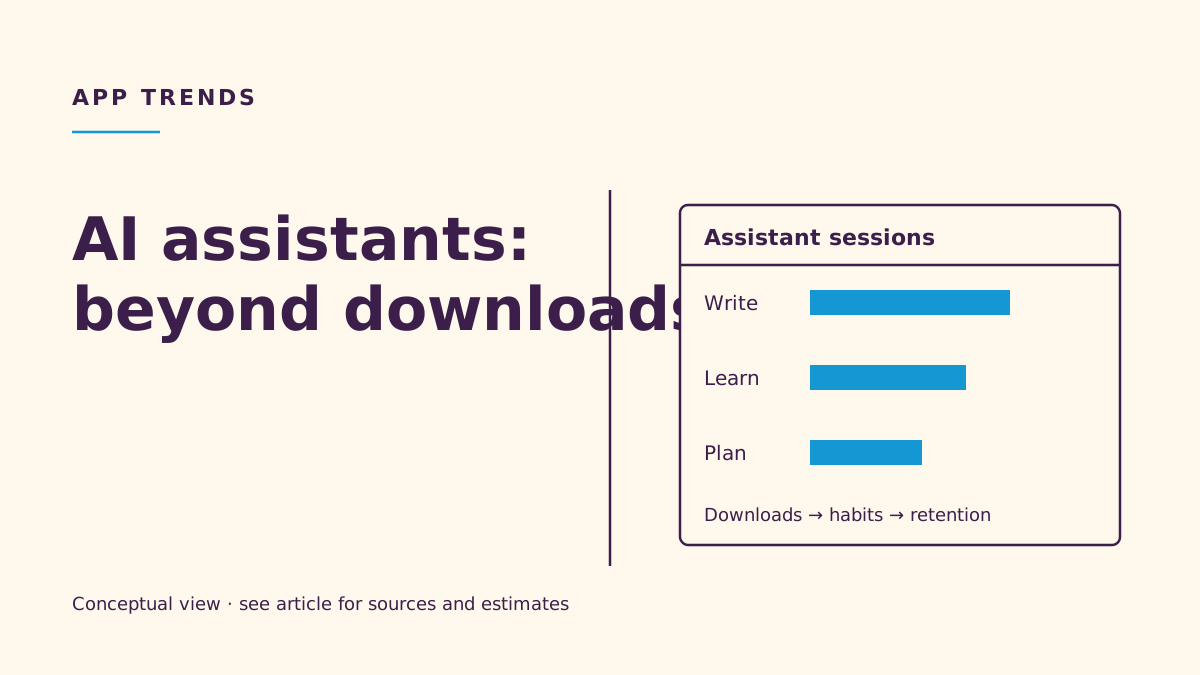
AI assistant apps moved from novelty to routine in 2025: worldwide downloads of generative AI apps doubled to 3.8 billion, while reported time spent reached 48 billion hours. Those figures describe an expanding category, but they do not tell us which tasks people value, whether installs become habits, or whether subscription revenue lasts.
Who should read what: everyday users can jump to “What people actually ask”; developers to “A practical plan for developers”; analysts to “How to read the numbers.”
Key takeaways
- Sensor Tower estimated 3.8 billion generative AI app downloads worldwide in 2025, twice the prior year; its category includes assistants and content generators.
- In OpenAI’s analysis of consumer ChatGPT conversations, everyday asking and practical guidance dominate; one product’s conversations are not a census of all assistant users.
- Downloads, active use, paid conversion, and retention are different measures. Read each with its date, platform coverage, and sampling limits.
- For builders, a repeated everyday job and a useful free experience are stronger product hypotheses than “AI” as a feature label.
How large is the AI assistant app market?
The clearest recent market snapshot is Sensor Tower’s 2026 State of Mobile: AI Moves Mobile into Its Next Phase, published in January 2026. Sensor Tower estimates that generative AI apps reached 3.8 billion downloads in 2025, double 2024, and more than $5 billion in in-app purchase revenue. It also reports 48 billion hours spent in these apps in 2025, about 3.6 times the 2024 total. These are estimates covering a broad category, not a directly audited count of human users or assistant-only activity.
“Downloads doubled YoY to reach 3.8 billion, while IAP revenue nearly tripled to exceed $5 billion.”
— Sensor Tower, 2026 State of Mobile
The earlier State of AI Apps Report 2025 offers a useful within-year view: downloads neared 1.7 billion during the first half of 2025, and category downloads grew 67% compared with the second half of 2024. Sensor Tower counted 470 million ChatGPT downloads across iOS and Google Play in that half-year, approximately 3.7 times the next closest competitor, DeepSeek. By June 2025, its estimated all-time downloads were 940 million for ChatGPT, 200 million for Gemini, and 127 million for DeepSeek. Those are cumulative store downloads, not active users; reinstall rules, preloads, web use, and store coverage all shape what the totals mean.
“ChatGPT’s 470 million global downloads across iOS and Google Play in H1 2025 were roughly 3.7X the next closest competitor (DeepSeek)”
— Sensor Tower, State of AI Apps Report 2025
Rankings are also a snapshot of momentum, not a permanent leaderboard. A launch can spike downloads in a particular region, while a built-in assistant or web product can be used without creating a new app install. For developers, this means a top chart position is evidence of distribution and curiosity, not proof of retention or a defensible product.
What do people actually ask AI assistants to do?
Usage research suggests that mundane utility is central. OpenAI’s September 2025 report, How people are using ChatGPT, describes an analysis of 1.5 million consumer conversations. It groups 49% of messages as “Asking,” 40% as “Doing,” and 11% as “Expressing.” The study says three-quarters of conversations focus on practical guidance, information seeking, and writing. It covers ChatGPT consumer plans and classifies conversations through automated analysis; it cannot establish the distribution of tasks across every AI app.
OpenAI’s How people are using ChatGPT study reports that about three quarters of conversations are about practical guidance, seeking information and writing.
A separate US poll gives a broader but different lens. The Associated Press-NORC Center poll reported that 60% of US adults and 74% of adults under 30 use AI to find information at least sometimes. The poll asked people about eight uses and surveyed 1,437 adults in July 2025; it measures reported behavior, not observed app sessions. The contrast matters: OpenAI categorizes actual ChatGPT conversations, while AP-NORC asks a representative US sample what they say they do.
An AP-NORC poll found that searching for information is the most common way Americans say they have used AI among the options offered.
For everyday users, that points to a realistic way to judge an assistant: does it help with a recurring job such as explaining a confusing topic, shaping a first draft, or planning a meal? Treat fluent answers as suggestions to verify when accuracy matters. For the studio, this resembles a useful design principle in casual apps: a clear, repeatable user need matters more than a long feature list. Our puzzle catalog ranges from word searches to merge puzzles; each gives someone a concrete activity rather than a vague promise.
What the numbers say about regions and reach
Growth does not distribute evenly. Sensor Tower estimated that Asia’s generative AI app downloads grew 80% from the second half of 2024 to the first half of 2025, compared with 51% in Europe and 39% in North America. North America’s share of category downloads fell from roughly 20% at an earlier stage to 11% in H1 2025 even as the region continued growing. In the same period, Sensor Tower put North American AI app in-app purchase revenue at $762 million, up 74% half over half; ChatGPT represented 63% of category revenue worldwide.
“Asia has expanded its lead as the top market for Generative AI downloads, including rapid growth in markets like India and China Mainland.”
— Sensor Tower, State of AI Apps Report 2025
OpenAI’s report adds a different kind of geography comparison: by May 2025, its estimated ChatGPT adoption growth rates in the lowest-income countries were more than four times those in the highest-income countries. This is relative growth, not a statement that adoption levels are equal. A fast-growing smaller base can still be smaller in absolute terms. Regional app-store rankings, survey prevalence, and a provider’s own adoption rates should not be merged into one “global usage” figure.
Retention and paid conversion: what can we responsibly infer?
Downloads are the beginning of a funnel. A useful sequence is: install, first successful task, repeat use, trial start, paid conversion, renewal. Each stage needs its own cohort and denominator. Comparing a download estimate with subscriber data from an opt-in platform dataset can help frame questions, but it cannot produce a universal conversion rate.
RevenueCat’s State of Subscription Apps 2025 draws on anonymized performance from 75,000 subscription apps using its platform and more than $10 billion in tracked revenue. Its online preview says AI apps had revenue per install above $0.63 at day 60, about twice the overall median of $0.31. It also says nearly 30% of annual subscriptions are cancelled during the first month. This is a benchmark of apps in RevenueCat’s ecosystem, not all AI apps; revenue per install is not profit, and app-level averages can hide wide variation.
“AI alone won’t drive success, differentiation does.”
— RevenueCat, State of Subscription Apps 2025
The company’s 2025 page also reports that day-35 download-to-paid conversion is consistently higher on Apple’s App Store than Google Play across categories. That is a cross-category subscription benchmark, not an AI-only result. Its preview notes that 82% of trial starts happen on install day, while its cancellation section identifies “not enough usage” as the leading Google cancellation survey response across categories, ranging from 32% to 47%. These observations suggest that early clarity and recurring value deserve measurement. They do not prove that an early paywall or a particular retention tactic will work for a specific assistant.
A practical plan for developers
For developers, the opportunity is to make one job easier and earn repeat use. NabiGame Studio has made casual games since 2016, and our experience with compact mobile products makes us cautious about adding features before a core loop feels worthwhile. An assistant has a different loop, but the same product question applies: what reason does someone have to return?
- Pick a narrow job. Start with a recognizable task, such as turning notes into a checklist or explaining a bill. State what the assistant can and cannot do.
- Make the first result useful. Show a working example before asking for extensive profile data or payment details. Let users revise, copy, save, or share the result.
- Instrument the journey. Track activation as a completed user outcome, then measure repeat completion by cohort. Separate organic installs, campaigns, iOS, Android, and web.
- Test payment against demonstrated value. Compare trial and free experiences using conversion and renewal cohorts, refunds, support requests, and user feedback. A click on a paywall is not evidence of lasting value.
- Plan for local fit. Test language quality, price presentation, connectivity, and payment behavior market by market instead of assuming one English-language funnel travels unchanged.
In our experience, a small and legible product promise is easier to evaluate than a broad claim that an app can “do anything.” For teams building apps as well as games, our studio services page describes the kinds of product work we take on. We also maintain an apps and community tools page for practical projects beyond games.
How to read the numbers without buying the hype
Analysts should keep four distinctions visible when they summarize this market:
- Downloads versus people: store estimates count downloads under a vendor’s methodology; they do not count unique people across devices or capture all web and bundled use.
- Time spent versus value: hours and sessions indicate attention, not accuracy, satisfaction, or task completion.
- Revenue versus economics: in-app purchases omit some web billing and do not subtract inference costs, user acquisition, refunds, or support.
- Survey versus telemetry: surveys can capture behaviors outside a single product, but depend on recall and wording; product telemetry is more granular but describes only that product’s users.
Sensor Tower’s January 2026 report estimates that all mobile apps and games generated $167 billion in global in-app purchase revenue in 2025, up 10.6% year over year. It estimates total iOS and Google Play downloads at nearly 150 billion, up 0.8%, and app time at 5.3 trillion hours, up 3.8%. The report says generative AI accounted for a rapidly growing slice of attention. The wider market context is a useful antidote to treating AI’s rapid growth as proof that every app category is expanding at the same pace.
“The fact that session growth is accelerating faster than downloads suggests Generative AI apps are shifting their focus from acquiring new users to deepening engagement among existing ones.”
— Sensor Tower, 2026 State of Mobile
That sentence is an interpretation of aggregate growth rates, not evidence that each app retains its cohorts better. To test the claim for a specific product, ask for cohort retention, usage frequency, and paid renewal by acquisition channel and region. If no one publishes those numbers, say so plainly. A market can be booming while many individual products fail to build a habit.
Our rule of thumb is to treat downloads as discovery, repeated task completion as product evidence, and renewals as a more demanding signal of ongoing value. If you are exploring a mobile or web app idea and want a practical conversation about scope, contact NabiGame Studio.
FAQ
Which AI assistant app has the most downloads?
Sensor Tower estimated ChatGPT had 470 million downloads across iOS and Google Play in the first half of 2025, about 3.7 times the next closest competitor, DeepSeek. Rankings can vary by date, country, and measurement provider.
Do app downloads show how many people actively use AI?
No. Downloads may include repeat installs and do not count people using web versions or built-in assistants. Active users and time spent are separate measures.
What do people use AI assistants for most?
OpenAI’s 2025 analysis found that consumer ChatGPT conversations often involve practical guidance, information seeking, and writing. AP-NORC’s US poll likewise found information search was the most common of its listed AI uses.
Do AI apps convert downloads into paid subscribers better?
RevenueCat’s 2025 subscription-app data showed AI apps above its overall median revenue per install at day 60. This dataset covers its platform customers and reports revenue per install, not a universal download-to-paid rate for AI apps.
Why do regional comparisons need care?
Markets differ in store access, language, purchasing power, distribution, and the availability of preinstalled or web-based tools. A faster growth rate can reflect a smaller starting base, so compare both rates and absolute levels.
Sources
- Sensor Tower, 2026 State of Mobile: AI Moves Mobile into Its Next Phase
- Sensor Tower, Tech Giants Drive Rapid Growth for Generative AI Apps in 2025
- OpenAI, How people are using ChatGPT
- Associated Press, How US adults are using AI, according to AP-NORC polling
- RevenueCat, State of Subscription Apps 2025

Comments
Loading comments…